Most Reddit product searches fail because people look for their brand name, find a few scattered mentions, and assume there is no demand. The better opportunities are usually phrased as problems: someone needs a tool, has a budget, dislikes their current option, or wants advice before making a purchase.
To find product recommendation posts on Reddit, search for the need behind your product, identify communities where people ask for help, and qualify each thread before replying. The goal is not to jump into every discussion. It is to find the conversations where your expertise or product genuinely helps someone make a decision.
Define the recommendation conversation you want to find
Not every product mention is a buying opportunity. A broad review, a troubleshooting question, and a casual complaint may be useful for research, but they are different from a person actively asking what to buy.
High-intent recommendation posts tend to reveal a need plus one or more constraints. The writer may mention a budget, a deadline, a feature requirement, a current tool they dislike, or a specific use case. Those details make it possible to decide whether you can offer useful guidance.
Use a simple relevance standard: the thread should describe a real problem your product can credibly solve. If the fit requires you to stretch the product's purpose or ignore an obvious limitation, it is not a strong engagement opportunity.
Signals that a Reddit post has buying intent
Look for direct language such as "looking for," "what should I buy," "best alternative," "is it worth it," "recommendations," "under $X," or "for my use case." A post such as "Looking for a project management tool under $50 per month for a five-person agency" is far more actionable than "What does everyone think about project management tools?"
Three factors raise the value of a thread: recency, specificity, and an unanswered question. A post from the last day with a clear requirement and few helpful replies is often worth more than a months-old thread with hundreds of comments and an obvious consensus.
Pay attention to switching language, too. Someone asking for an alternative to a named competitor may already know the category and be closer to a decision than a person starting from scratch.
Build keyword searches around needs, not just your product name
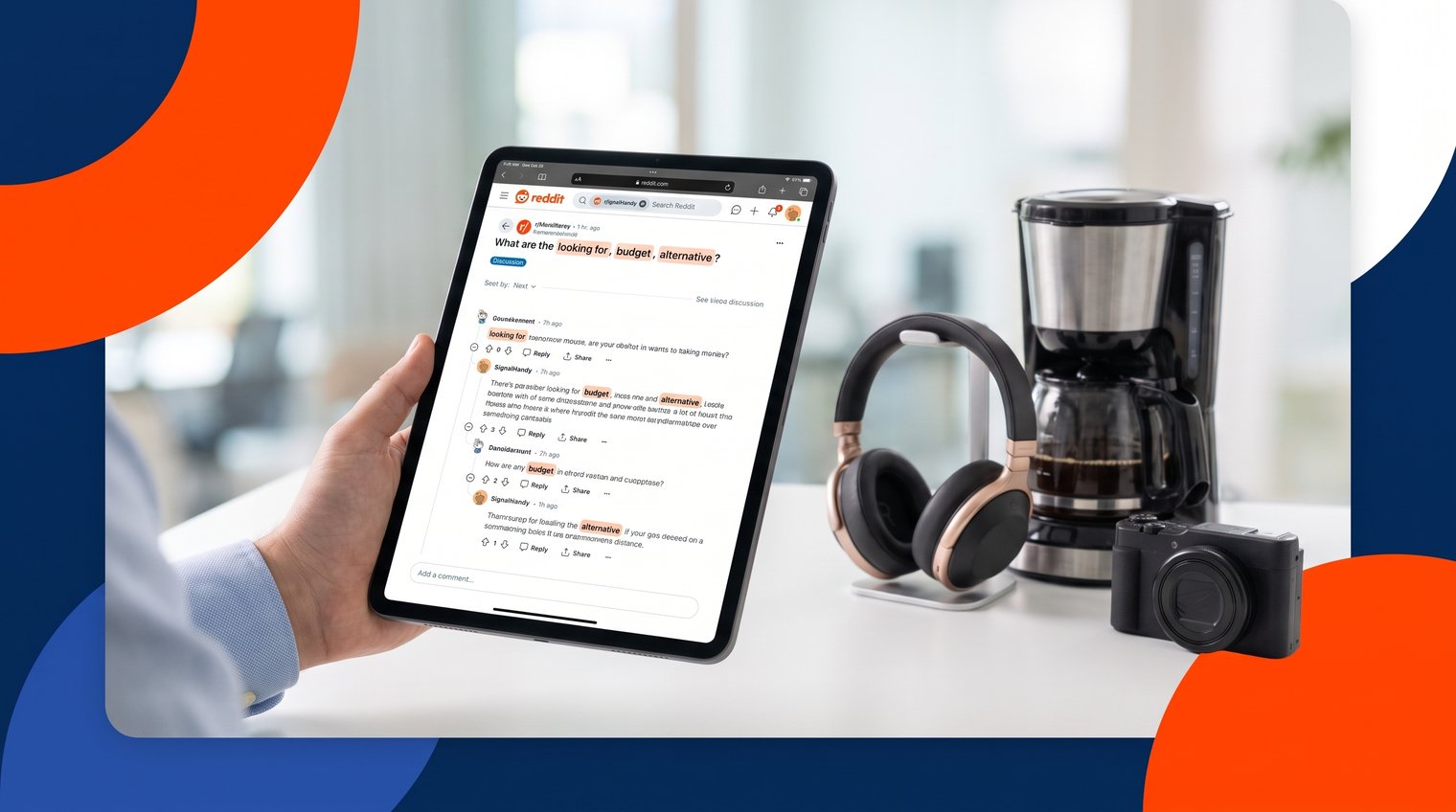
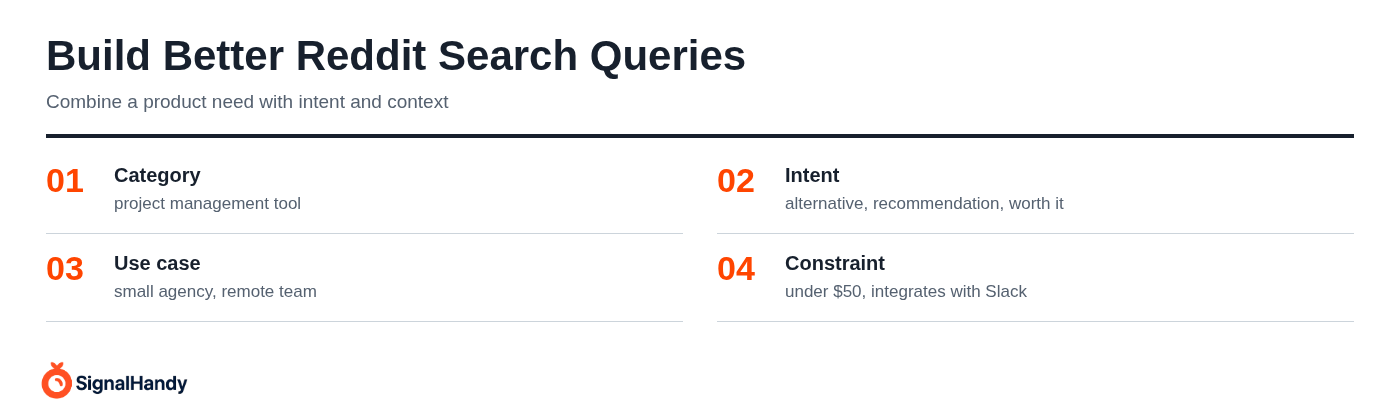
A brand-name search tells you who already knows you. A need-based search reveals people who may need what you offer but have never heard of it. Start with the category, then combine it with language that signals recommendation intent.
Think about the job your customer is trying to do. For a Reddit monitoring tool, that might include finding brand mentions, tracking competitor conversations, discovering buyer intent, or spotting relevant discussions before they go cold. For any product, the same logic applies: search the problem, use case, audience, and constraint.
Useful starting patterns include:
- Category + intent: "CRM recommendations," "best email marketing platform," or "accounting software worth it"
- Use case + need: "tool for a remote sales team" or "software for managing client approvals"
- Pain point + solution: "alternative to spreadsheets for inventory" or "how to track competitor mentions"
- Audience + constraint: "best invoicing tool for freelancers under $20" or "simple CRM for a two-person startup"
Use recommendation and comparison modifiers
Recommendation modifiers make a broad category search much more useful. Test phrases such as "best [category]," "[category] recommendations," "[product] vs," "alternative to [competitor]," and "what should I buy for [use case]."
For example, a company selling customer-feedback software might search for "feedback tool recommendations," "alternative to [competitor]," "best way to collect product feedback," and "[competitor] vs." Each query catches a different stage of evaluation.
Alternative requests deserve particular attention. A Redditor looking for a replacement often has an existing budget, knows what is not working, and is open to a change. Read the reason they are leaving before deciding whether your product belongs in the conversation.
Add context that qualifies the buyer
Once you find useful broad searches, add qualifiers that indicate fit. Strong modifiers include budget, location, team size, experience level, required compatibility, urgency, and use case.
For instance, rather than searching only for "social listening recommendations," try variations such as "Reddit monitoring for startups," "brand monitoring tool for a small team," or "competitor monitoring that works with Slack." The additional context filters out threads that are unlikely to convert into a relevant conversation.
Do not over-narrow the first query. A common mistake is adding every desired feature, budget, audience, and location at once, then concluding Reddit has no relevant discussions. Begin with a category and intent phrase, review the wording people use, and refine from there.
Search Reddit directly and use its filters
Reddit's native search is the fastest place to validate obvious phrases and find recent conversations. On desktop, enter one search phrase at a time, review the available result tabs, and narrow the results to the communities that matter most.
For active buying requests, prioritize recent results first. If you are researching language, objections, or established community recommendations, sort more broadly and review older discussions as well. Reddit search is useful, but it will not catch every wording variation and may not surface relevant comments consistently.
Use it as one discovery method, not the entire workflow.
Search within a Reddit community on desktop
To search within a subreddit, open the community first and use its search function when available. Enter a category-plus-intent phrase, such as "CRM recommendations," "alternative," or "best tool for agency," then inspect the results in the context of that community.
You can also use a subreddit-qualified query where Reddit makes that option available. Test short variations rather than one long keyword string. For example, in a community for small businesses, search separately for "recommendations," "software," "alternative," and the core product category.
Check both Posts and Comments when those result views are available. The original post may be about a broader topic, while the actual purchase request appears in a comment such as, "Does anyone have a cheaper alternative?"
Search from the Reddit app without losing precision
If you need to find product recommendation posts on the Reddit app, start inside the relevant community when that search option is available. Run the same short phrase variations you would use on desktop, then open the full thread before deciding whether it is relevant.
Mobile filtering can be more limited, so save promising posts and searches for later review. When a thread matters, revisit it on desktop to compare related results, inspect comments more carefully, and check the community rules.
Do not rely on a post title alone. On mobile especially, it is easy to mistake a general discussion for an active request until you read the body and follow-up comments.
Use Google to uncover Reddit threads Reddit search misses
Google is often better at finding older Reddit threads, exact phrasing, and discussions that Reddit's own search does not rank well. A targeted Google search can also reveal how people describe a problem outside the language your marketing team uses.
Use site:reddit.com to limit results to Reddit, then add the category, pain point, comparison term, or community you want to investigate. This is especially helpful when a generic Reddit-wide search produces too many loosely related results.
A high-ranking Google result is not automatically a good opportunity. Open the thread, confirm that the discussion is authentic and current enough to matter, and make sure the community permits the type of participation you have in mind.
Use site:reddit.com queries for broad discovery
Start with simple reusable syntax:
- site:reddit.com "[category]" "recommendations"
- site:reddit.com "alternative to [competitor]"
- site:reddit.com "[use case]" "what should I buy"
- site:reddit.com "[product category]" "worth it"
Quotation marks tighten the search to an exact phrase. If irrelevant topics keep appearing, use a minus term to remove them. For example, a business software company may add -gaming or -student when those audiences are outside its market.
Target known communities with site searches
When you know a community produces useful discussions, search it directly in Google. Use a format such as site:reddit.com/r/[subreddit] "best" "[category]".
This approach can beat native search in large communities, for older discussions, and for terms that attract too many irrelevant Reddit-wide matches. It is also a practical way to compare how different communities talk about the same product need.
For example, a team selling tools to agencies may compare recommendation threads from agency-focused communities with discussions in entrepreneur or small-business communities. The needs may overlap, but the decision criteria can be very different.
Find the communities where recommendation requests actually happen
The obvious product subreddit is rarely the only place buyers ask for help. Many requests appear in communities built around a profession, hobby, business model, life event, or recurring problem. A founder may ask for software recommendations in a startup community, while a marketing manager may ask the same question in a niche community for their role.
Before you spend time monitoring a subreddit, inspect its rules, recurring discussion formats, and moderation style. Some communities welcome transparent product recommendations. Others prohibit self-promotion, affiliate links, or vendor participation entirely.
For a broader process for identifying suitable communities, see how to find relevant subreddits for your target audience.
Also look at who asks questions and who answers them. A community full of peer-to-peer practical advice may be valuable even if it has fewer members than a large general-interest subreddit.
Look for recurring recommendation formats
Recurring formats are easier to monitor than random one-off posts. Look for weekly help threads, pinned buying guides, request flairs, comparison megathreads, and "ask the community" posts.
These formats tell you where recommendation conversations are likely to appear and how the community expects them to be handled. They can also reveal whether vendors are allowed to participate, whether links are discouraged, and what level of disclosure is expected.
Build a short list of communities that consistently produce relevant questions rather than trying to monitor every subreddit related to your category.
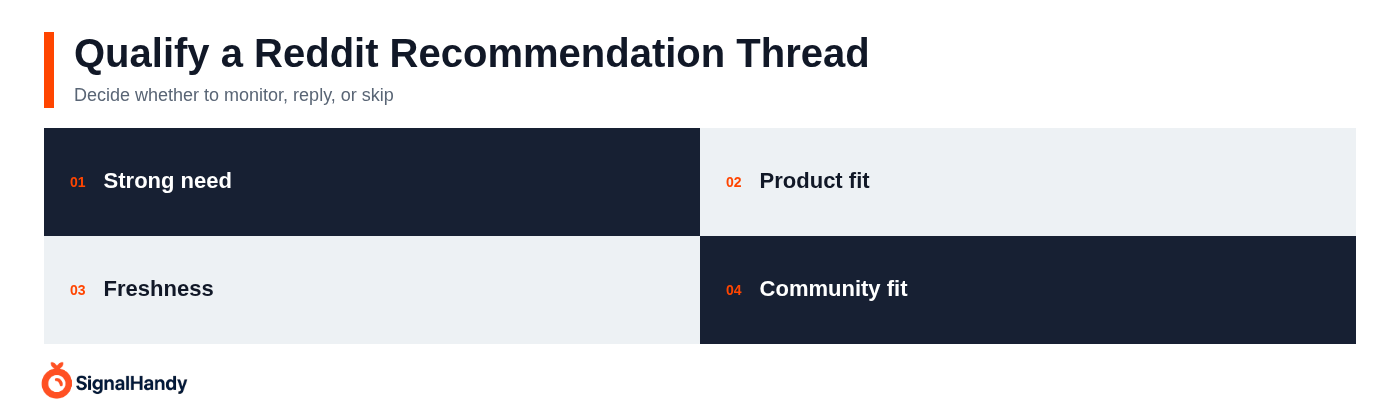
Screen each thread for relevance, intent, and timing
Do not treat every keyword match as a lead. A practical qualification process protects your time and reduces the chance of an awkward or irrelevant reply.
Prioritize threads where the user has a defined need, is evaluating options now, and could still benefit from another informed answer. A narrowly framed request from a recent post is often more valuable than a popular thread with broad interest but no clear buyer.
Skip or deprioritize stale discussions, vague prompts, requests outside your product's fit, threads with strict no-promotion rules, and conversations where the poster has already selected a solution. A thread that is technically relevant but no longer useful is not an opportunity.
Score the opportunity before you engage
Use a simple five-factor score to sort threads quickly. Rate each factor from 0 to 2, then prioritize threads with higher totals:
| Factor | What to look for |
|---|---|
| Intent strength | Clear request for recommendations, comparison, or purchase advice |
| Product fit | Your solution addresses the stated problem without stretching the fit |
| Freshness | The discussion is recent enough for a useful response |
| Visibility | Relevant community activity, useful comment volume, or meaningful audience fit |
| Invitation to respond | The poster explicitly asks for input and the conversation remains open |
A highly specific request with modest engagement can be more valuable than a heavily upvoted general discussion. Specificity usually means the person has moved beyond casual browsing and is trying to make a real decision.
Read the full thread before deciding how to respond
The original post is only the starting point. Follow-up comments may reveal a deal-breaker, a tool the person already tried, a budget change, or a detail that makes your product unsuitable.
Read the poster's replies, the strongest existing answers, and any moderation comments. This gives you the context needed to add something useful rather than repeating advice that has already been covered.
Sometimes the right conclusion is not to mention your product at all. If the buyer needs a feature you do not offer, or the community has already identified a better-fit option, a forced recommendation will damage trust.
Reply helpfully without turning a recommendation thread into an ad
A useful Reddit reply addresses the person's stated decision criteria. A promotional reply talks about your product before demonstrating that you understand the problem. Reddit users can spot the difference immediately.
A strong structure is simple: acknowledge the key requirement, offer an option or decision principle, explain the trade-off, disclose your affiliation when applicable, and answer follow-up questions honestly. Keep the response specific to the thread instead of copying a pitch from another community.
Never dump links, paste generic feature lists, or imply that your product is the best choice for every situation. Reddit users who want to add tracking should also review how to use UTM links in Reddit comments without losing trust. If rules prohibit promotional replies, follow the rules. If a competitor is objectively better for the stated need, say so or stay out of the thread.
Match the reply to the user's decision criteria
Suppose someone asks for a tool that works for a small remote team, takes little time to set up, and integrates with Slack. A helpful answer compares those criteria directly:
"For a small remote team, I would prioritize setup time and notification quality over a huge feature set. Check whether each option can send the alerts you need into Slack and whether it covers the channels that matter to you. If you need ongoing Reddit conversation monitoring, SignalHandy is built around keyword alerts and prioritizing relevant discussions; I am affiliated with it, so compare it against your other requirements before choosing."
The answer is concise, transparent, and tied to the user's criteria. It does not pretend that every buyer needs the same thing.
Turn one-off searches into a repeatable monitoring workflow
Manual searching is useful for learning the market, but it becomes unreliable when you need consistent coverage. Turn your research into keyword groups that can be reviewed on a predictable cadence. A Reddit keyword monitor can help organize that ongoing discovery.
Create separate groups for product categories, customer pain points, competitor alternatives, and use cases. For example, a growth team might track "Reddit monitoring," "brand mentions on Reddit," "alternative to [competitor]," and "how to find buyer conversations on Reddit." Keep the groups distinct so you can see which themes produce qualified threads.
Log each relevant thread with its URL, subreddit, intent signal, product fit, status, and follow-up context. This prevents duplicate replies, helps teammates coordinate, and creates a useful record of common objections and competitor mentions. If several people share the workflow, how to route Reddit mentions to the right team can help with assigning follow-up.
Use SignalHandy to monitor relevant Reddit conversations
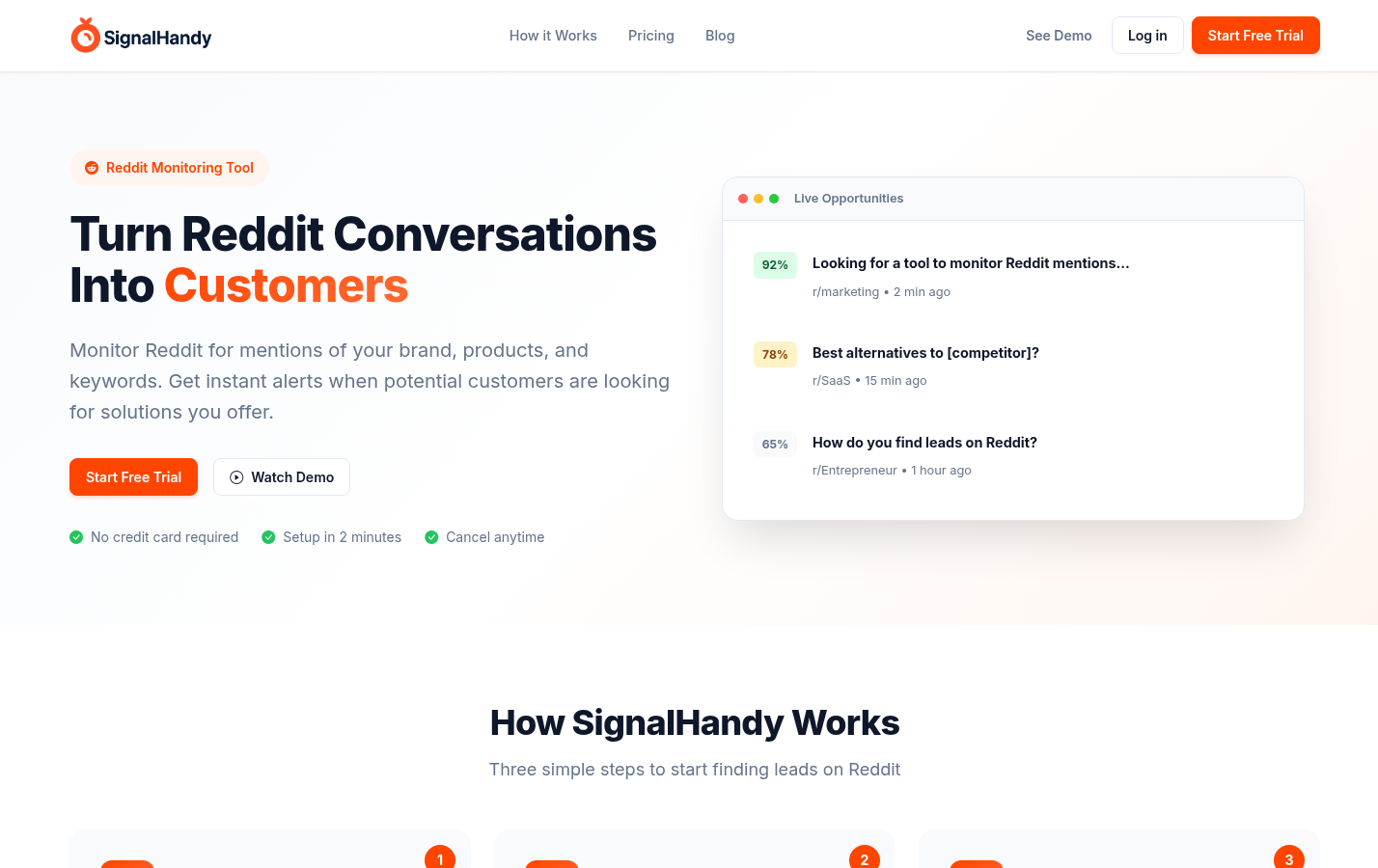
When manual searches become too slow, SignalHandy can help teams monitor Reddit keywords across posts and comments. You can track brand names, competitors, product categories, and pain-point language, then receive alerts for relevant conversations.
SignalHandy also scores opportunities for business relevance and provides reply suggestions, which can speed up triage when several conversations appear at once. It is useful for teams that need to catch recommendation requests and alternative discussions without repeatedly rerunning the same searches.
Automation does not replace judgment. Review the full context, confirm the product fit, and check subreddit rules before using or adapting any suggested reply.
Track outcomes and refine the searches that find buyers
Finding threads is only half the job. Measure which searches uncover qualified opportunities and which merely create noise.
Track the number of qualified threads found, replies posted, response quality, useful engagement, clicks where appropriate, conversions, and recurring objections. A low-volume keyword may be a strong performer if it consistently finds people with a clear need and good product fit.
Use poor-fit threads to improve your filters. Add negative terms when a search repeatedly produces irrelevant audiences or use cases. Use successful threads to expand your keyword library with the exact phrases buyers use, especially the problem descriptions and comparison language that did not appear in your original list.
The language in real Reddit conversations is often more valuable than internal assumptions about how customers describe their needs.
Find better Reddit recommendation opportunities consistently
The most reliable process is straightforward: search for needs and alternatives, identify communities that welcome the discussion, qualify the thread, read the full context, and respond only when you can add genuine value.
That approach produces better conversations than chasing every brand mention or posting the same product pitch across unrelated threads. It also helps you learn what buyers actually care about before they choose a solution.
If ongoing manual searching is too slow, SignalHandy can monitor relevant Reddit conversations, surface higher-priority opportunities, and help your team stay on top of recommendation requests without relying on one-off searches alone.