Most teams treat Reddit as a source of colorful quotes. That is a mistake. Used casually, it can reinforce whatever you already believe; used systematically, it reveals the language people use when they are frustrated, comparing options, solving problems with awkward workarounds, or trying to explain why a purchase did not work out.
Reddit research is the structured analysis of public Reddit conversations to inform a decision. It is not scrolling until you find a post that supports a product idea. The goal is to collect context, identify recurring patterns, test competing explanations, and turn those observations into evidence-backed next steps for marketing, product, content, or competitive strategy.
What Reddit Research Can Tell You That Surveys and Search Data Miss
Surveys are useful when you need to ask a defined audience the same questions. Search data is useful when you want to understand demand patterns at scale. Reddit fills a different gap: it captures people discussing a problem in their own words, often before a researcher has decided which answer choices to offer.
That makes Reddit especially valuable for finding the context around a need. A person may not simply say they need a better project management tool; they may explain that they are copying updates between Slack, spreadsheets, and client emails every Friday, fear missing an approval, and cannot justify adding another expensive subscription. That thread contains a pain point, a workflow, an objection, and a buying constraint.
Good Reddit research can surface:
- The phrases customers use to describe a problem and the outcome they want.
- Workarounds that indicate an unmet need or product gap.
- Objections that prevent adoption, including price, trust, complexity, and switching effort.
- Alternatives people actually consider, including manual methods and non-obvious competitors.
- Community norms that influence how people evaluate recommendations and brands.
It is not a shortcut to statistically representative market research. Reddit users are not a random sample of your market, and the loudest or most upvoted opinion is not automatically the most common one. Treat Reddit as a source of directional qualitative insight, then validate important conclusions with customer interviews, product data, surveys, sales calls, or other evidence.
When Reddit is a reliable source for research
Reddit becomes more reliable when the same underlying pattern appears across multiple threads, communities, and recent time periods. A detailed first-person account from someone describing their workflow is generally more useful than a vague complaint, especially when other people independently describe a similar situation.
Look for repeated language, consistent triggers, and comparable trade-offs. If users in several relevant communities say they are leaving a category because setup takes too long, that is worth investigating. If one highly upvoted post makes the claim and no other discussion supports it, you have a lead, not a finding.
Triangulation matters. Compare Reddit observations with support tickets, review sites, interview notes, search behavior, win-loss data, and your own product analytics where possible. Also check recency: a complaint about a product feature from two years ago may be irrelevant if the product has changed.
A quick-start Reddit research workflow
A disciplined workflow prevents the research from turning into an endless reading session. Start with a decision you need to make, then work backward to the evidence required.
- Define the decision and the question behind it.
- Select relevant communities and a reasonable time window.
- Build a keyword map around problems, outcomes, alternatives, and objections.
- Search and capture complete thread evidence, not isolated snippets.
- Tag the evidence consistently and group it into themes.
- Look for counterexamples, validate important patterns, and decide what to test.
- Share a clear recommendation with the team that can act on it.
The rest of this guide expands that workflow in detail.

Start With a Research Question and a Decision to Make
"Learn what customers want" is too broad to guide useful research. A better starting point ties the work to a real decision: Should we change our homepage message? Which onboarding problem should product investigate? What content should we create for buyers comparing alternatives? Which segment should sales prioritize?
For example, instead of researching "what founders think about analytics software," ask: "What causes early-stage SaaS founders to abandon analytics tools after trial, and which message would reduce that concern on our pricing page?" That question tells you which people to study, which conversations matter, and what evidence would be actionable.
Before searching, set four boundaries:
- Audience: Who are you trying to understand?
- Category: What product, problem, or behavior is in scope?
- Time window: Are you studying current sentiment, a seasonal issue, or a long-running need?
- Evidence threshold: What would count as enough support to justify a recommendation?
Without these boundaries, it is easy to overvalue interesting discussions that do not apply to the customer or decision at hand.
Use a research brief that prevents confirmation bias
Create a short research brief before opening Reddit. It does not need to be formal, but it should make your assumptions visible. That is the simplest defense against cherry-picking quotes that validate an existing roadmap item or campaign idea.
Include the research question, current hypothesis, target communities, time period, and terms you plan to test. Add a section called "what would change our mind." If you believe customers reject a competitor because of price, for example, state the evidence that would disprove it: perhaps users repeatedly say the tool is worth the price but fails because it is difficult to implement.
Also record the decision the research will inform. A useful brief might say: "Decide whether to lead our campaign with faster reporting or easier team adoption." That keeps the final output focused on a choice rather than a collection of observations.
Choose the Right Subreddits Before You Search
The best subreddit is rarely the largest one. Subscriber count tells you little about whether members are your buyers, whether discussions are substantive, or whether people can openly discuss the issue you are studying.
Build a mix of community types. Buyer communities reveal evaluation criteria and purchase concerns. Practitioner communities reveal daily workflows and technical realities. Support or problem communities often expose frustrations and workarounds. Adjacent-interest groups can show the broader context in which a problem appears. Competitor-specific subreddits may surface switching triggers, though they also tend to attract unusually frustrated users.
Evaluate a community by audience fit, posting activity, moderation quality, recurring discussion depth, and how searchable its content is. A smaller, active subreddit with detailed posts can be far more useful than a broad community filled with memes, news links, or low-context questions.
Map the communities around a customer problem
The same person may discuss the same underlying need differently depending on the community. A small business owner might ask for a tool recommendation in a professional subreddit, describe the resulting workflow failure in a support community, and discuss budget constraints in a founder group. Looking in only one place gives you a partial story.
Start with one obvious subreddit, then expand outward. Review related community suggestions, note where users say they cross-posted a question, and look at the communities active contributors participate in. User profiles can be useful for discovering adjacent groups, but do not collect unnecessary personal information or treat individual activity as representative of a segment.
Make a simple community map with each subreddit, its primary audience, typical conversation type, and likely research value. This lets you compare patterns between communities instead of blending unlike audiences together.
Read community rules and culture as research data
Subreddit rules shape what people say. Some communities ban self-promotion, vendor comparisons, or support requests. Others direct recurring questions into weekly threads. If you ignore those norms, you may mistake restricted conversation for a lack of demand.
Read the rules, pinned posts, and a sample of recent threads before drawing conclusions. Notice whether members prefer detailed case studies, quick recommendations, anonymous venting, or structured question formats. That culture changes both the evidence available and the respectful way to participate if you later decide to engage.
Build a Reddit Keyword Map That Captures Real Customer Language
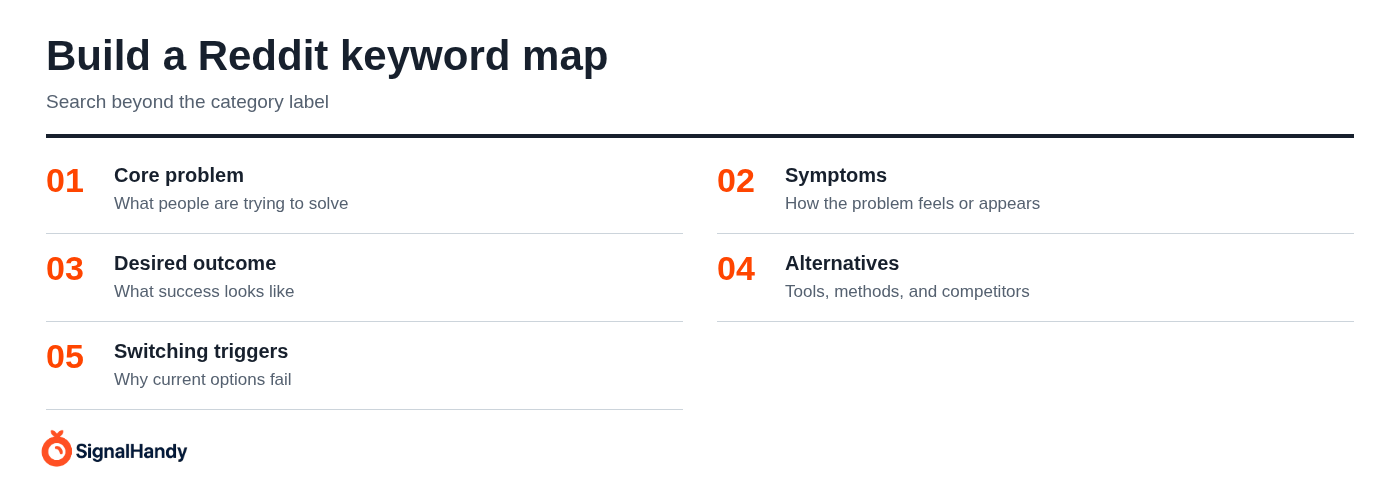
Searching one category term is not Reddit keyword research. People rarely describe their need using the exact language your company uses. A stronger approach is to build a keyword map that follows the problem from symptom to desired outcome, then includes alternatives and reasons for switching.
Start with the central research question. Around it, list terms in several layers: the core problem, symptoms, desired results, jobs people are trying to accomplish, feature language, objections, trigger events, manual methods, and competitor names. Save exact phrases as you find them; those phrases are often more useful for messaging and content than the category labels you started with.
Search for symptoms and workaround language
Symptoms are often more revealing than product categories. Search for phrases such as "how do I," "is there a way," "frustrated with," "alternative to," "what do you use for," and "anyone else struggling with." Pair them with the workflow or issue you are studying.
Workarounds are particularly valuable because they show that a problem is active enough for someone to spend time solving it. A user who exports data manually every week, maintains a private spreadsheet, or combines three tools may be signaling urgency, poor fit, or a missing integration. Do not assume every workaround is a market opportunity, but investigate repeated ones.
Include negative and switching-intent terms
Complaint and comparison language helps identify friction in an established category. Include terms related to cancellation, migration, alternatives, pricing, trust, complexity, support, bugs, setup, and "worth it." Search competitor names with phrases such as "switching from," "leaving," "replacement," or "regret."
These discussions can reveal why current options fail, but they should be handled carefully. A single complaint may reflect a unique account issue, an outdated experience, or a mismatch between the product and the user's needs. Treat it as a hypothesis to test, not a ready-made claim for your next campaign.
Search Reddit Efficiently Without Losing Context
Reddit's native search is useful for current discovery, but it is not perfect. Use it to find relevant posts, then review the entire thread and the comment chain around any quote you plan to capture. A search result can surface a phrase without showing whether the author solved the problem, changed their mind, or was challenged by knowledgeable commenters.
Use filters deliberately. Search within a subreddit when you want a cleaner sample from a defined audience. Search across Reddit when you are exploring vocabulary or looking for communities you missed. Where available, adjust sorting and time ranges to separate current concerns from enduring ones.
Useful query patterns include quoted phrases, combinations of a problem and outcome, and product or competitor comparisons. External search engines can also help uncover older or poorly indexed conversations.
Use native Reddit search for current conversation discovery
Different sorts answer different questions. Sorting by new helps you discover emerging conversations and fresh language. Relevance is useful for matching a precise query. Top may identify enduring, widely engaged threads, while sorting by comments can expose discussions that generated substantial back-and-forth.
Do not mix results without recording how you found them. Log the exact query, subreddit filter, sort order, time range, and date searched. This makes the work repeatable and helps you explain why one sample contains different evidence from another.
Use Google to uncover older, specific, and poorly indexed conversations
Google can be effective when native search misses an exact phrase or returns overly broad results. Try searches such as site:reddit.com/r/SaaS "switching from", site:reddit.com "manual reporting" "alternative to", or site:reddit.com/r/Entrepreneur "customer feedback" -jobs. Replace the subreddit and terms with your own research focus.
Search snippets are leads, not evidence. Open the thread, confirm the date and community, read the relevant replies, and capture enough context to understand what the person actually meant.
Collect Evidence in a Research Repository, Not a Bookmark Pile
Bookmarks are easy to save and almost impossible to synthesize. Use a spreadsheet, database, or research repository that lets you preserve evidence in a consistent structure. The aim is not to archive every interesting post; it is to retain the information needed to evaluate and revisit a finding.
For each item, capture the URL, date, subreddit, relevant author context if necessary, verbatim quote, surrounding context, initial theme, sentiment, and a directional frequency signal. Include a separate field for your interpretation. That distinction is essential: "The user exports data manually every Monday" is observed evidence; "Users need automated reporting" is an inference.
Handle public discussions with care. Keep only the personal information required to interpret the evidence, avoid unnecessarily identifying individuals in internal reports, and never turn one person's experience into a claim about an entire market.
Tag findings so they can answer business questions
A compact tagging system makes synthesis much faster. Use consistent tags such as pain point, job, trigger, desired outcome, objection, alternative, feature request, workflow, and vocabulary. You can add segment or lifecycle tags if those distinctions matter to your decision.
For example, a post about manually reconciling reports could receive the tags workflow, pain point, manual workaround, and time savings. Later, you can filter every item tagged with manual workaround and determine whether the same underlying need appears across communities.
Analyze Threads for Patterns, Not Isolated Quotes
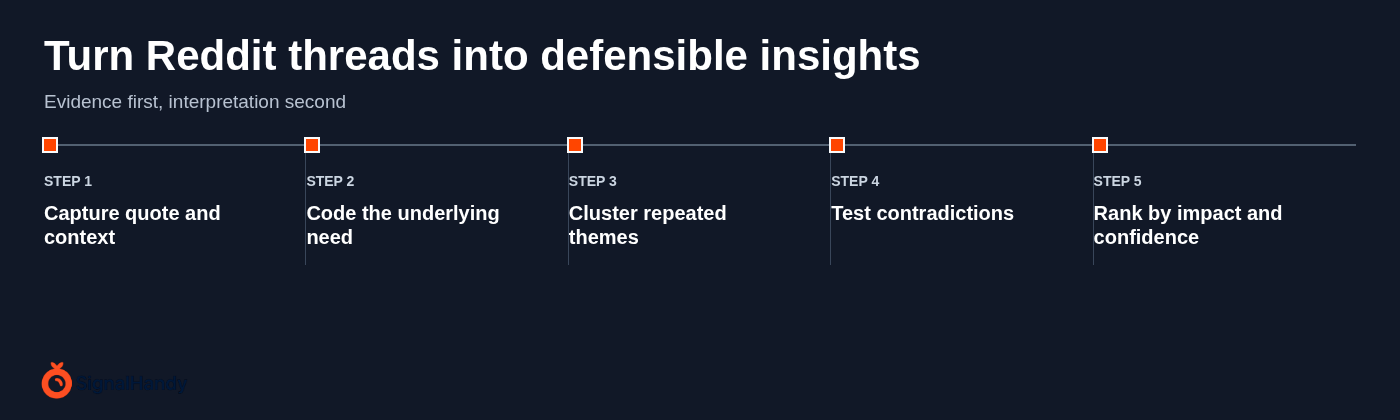
Qualitative coding is the process of labeling pieces of evidence so related observations can be grouped and analyzed. Read the thread for context, apply an initial code, then revisit the codes as patterns emerge. Several differently worded comments may point to the same need, while identical words may mean different things for different segments.
As you group themes, actively inspect contradictions. Are complaints concentrated among beginners while experienced users value the same complexity? Is the issue current, or tied to an old product version? Does one community have an incentive or culture that changes how members respond?
Frequency, voting, comment depth, and recency can help prioritize where to look next. They are not a popularity score and should not replace judgment.
Separate intensity, frequency, and strategic importance
A frequent minor annoyance is not always more important than a rare but severe failure. A small number of high-value customers unable to complete a critical workflow may deserve more attention than a common complaint about a cosmetic inconvenience.
Rank themes using four practical questions:
- Who is affected? Is the pattern relevant to a priority segment?
- How urgent is it? Does it block a task, delay a purchase, or merely create friction?
- How well does it fit the business? Can your product, message, or team realistically address it?
- How confident are you? Does the evidence repeat across credible, recent, contextual discussions?
This creates a more useful priority list than simply counting mentions.
Look for contradictions before writing a conclusion
Before finalizing a conclusion, deliberately search for disagreement. Review dissenting comments, compare different subreddits, examine another customer segment, and check whether the pattern persists over time. This is where a research brief's disconfirming evidence field pays off.
State boundaries in the final finding. Rather than saying, "Customers hate complex reporting," say, "In recent discussions among small agency operators, users described report setup as a barrier when they needed client-ready output quickly; we found less evidence that this matters to in-house analysts." The second statement is more honest and much more actionable.
A Worked Example: Finding Messaging Gaps From Reddit Discussions
Consider a hypothetical B2B software company that helps small agencies manage recurring client reporting. Its team wants to know whether its homepage should emphasize automation, client visibility, or ease of setup.
The research question is: "What makes agency owners dissatisfied with their current reporting process, and what outcome would make them consider changing it?" The team searches agency and marketing-practitioner communities using a keyword map that includes "client reporting," "manual reports," "reporting template," "alternative to," "hours every month," "client dashboard," and the names of common tools.
In the repository, the team records full-thread evidence rather than copying isolated complaints. It notices an emerging cluster: several users describe assembling reports manually, but they do not frame the issue as a desire for "automation." They say they need to stop spending the last business day of the month chasing screenshots and explaining metrics that clients do not understand.
From raw comments to a message hypothesis
The same cluster includes a useful contradiction. Some users distrust broad "automate your reports" promises because they have tried tools that produce generic dashboards requiring substantial cleanup. The outcome they value is not automation for its own sake. It is delivering a report that clients can understand without hours of preparation.
The finding might read: Among small agency operators discussing recurring reporting workflows, a repeated concern is the time spent preparing and explaining client reports. Broad automation claims may trigger skepticism when users expect cleanup work. A more credible message is a client-ready reporting process with less manual assembly.
The confidence level is moderate, not absolute. The evidence comes from a targeted set of public discussions, not a representative survey. The caveat is equally important: agencies with dedicated analytics staff may have a different need, and the research should not assume they prioritize the same outcome.
Turn the finding into an experiment
The team can now test a specific message instead of making a vague positioning change. One landing-page headline might be: "Create client-ready reports without the end-of-month screenshot scramble." Supporting copy could explain the workflow and show how reports reduce manual assembly, rather than making an unqualified automation claim.
Sales can add a discovery question: "How much time does your team spend preparing reports versus explaining them to clients?" Content can create a practical guide to standardizing client reporting. Product can investigate whether report customization and narrative context are the real adoption barriers.
Validate the hypothesis with follow-up evidence: conversion rates for message variants, sales-call responses, customer interviews, trial behavior, and retention among agency users. If those signals do not support the message, revisit the Reddit evidence and examine whether the original cluster was too narrow or misinterpreted.
Use Reddit Research for Market, Customer, Content, and Competitive Insight
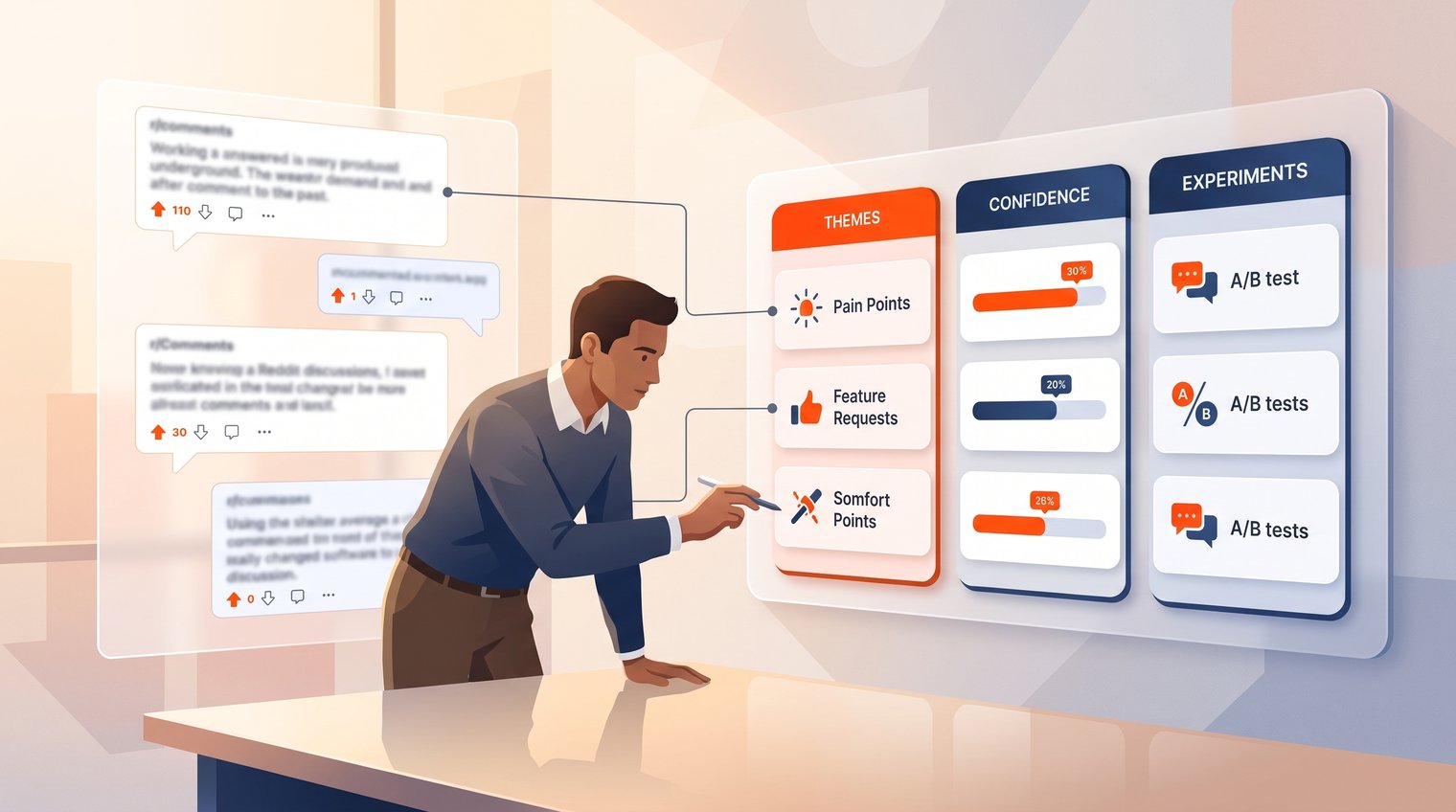
One well-maintained evidence base can support several teams, but each use case should produce a clear deliverable. A product team needs prioritized problems and open questions. A content team needs search-aligned topics and language. Sales needs objections and discovery prompts. Strategy teams need carefully qualified competitive patterns.
Market and category research
Reddit discussions can reveal category vocabulary, emerging needs, adoption barriers, and segments with different definitions of value. You may learn that experienced practitioners use a technical term while new buyers describe the same need as a simple time-saving problem. That distinction can improve positioning and segmentation.
Do not use Reddit discussions alone to make broad market-size or prevalence claims. Pair them with customer data, market sizing, survey work, and other quantitative sources before making decisions that depend on scale.
Customer and product discovery
For product discovery, look for jobs people are trying to complete, the triggers that make the problem urgent, current workarounds, friction points, feature expectations, and disappointments after purchase. These observations can improve interview guides and help product teams identify areas worth deeper investigation.
Reddit is not a replacement for direct customer research. You cannot ask follow-up questions, verify every detail, or know whether a commenter resembles your best customers. Use what you learn to sharpen customer interviews and backlog discovery.
Content and SEO research
Recurring questions, misconceptions, and terms can become strong content inputs. If people repeatedly ask how to evaluate a category, struggle with a concept, or compare two methods, you have evidence for a guide, FAQ, comparison page, or keyword cluster.
The value is not copying a Reddit comment into a blog post. It is understanding the search intent and vocabulary behind the question, then creating a genuinely useful resource that answers it clearly. As covered in the keyword-map section, symptom and outcome language is often more useful than formal category terminology.
Competitive research
Competitive conversations can show how users compare products, describe switching decisions, and identify capabilities they feel are missing. Pay attention to the conditions behind a comparison: company size, budget, technical skill, workflow complexity, and timing often explain why one option wins for one user and loses for another.
Never treat unverified accusations, rumors, or one-off complaints as established competitive intelligence. Preserve the original context, look for repeated evidence, and frame conclusions as qualified observations.
Scale Ongoing Reddit Monitoring With the Right Tooling
Manual research is enough for a narrow, one-time question. If you are studying a single audience over a defined period, native search and a well-designed repository provide control over sampling and coding.
Monitoring becomes more valuable when the same keywords matter continuously, when relevant conversations appear across many communities, or when timely participation is part of the team's workflow. The purpose of a Reddit research tool is not to replace interpretation. It is to reduce the manual effort of discovering relevant new threads.
SignalHandy for keyword monitoring and opportunity triage
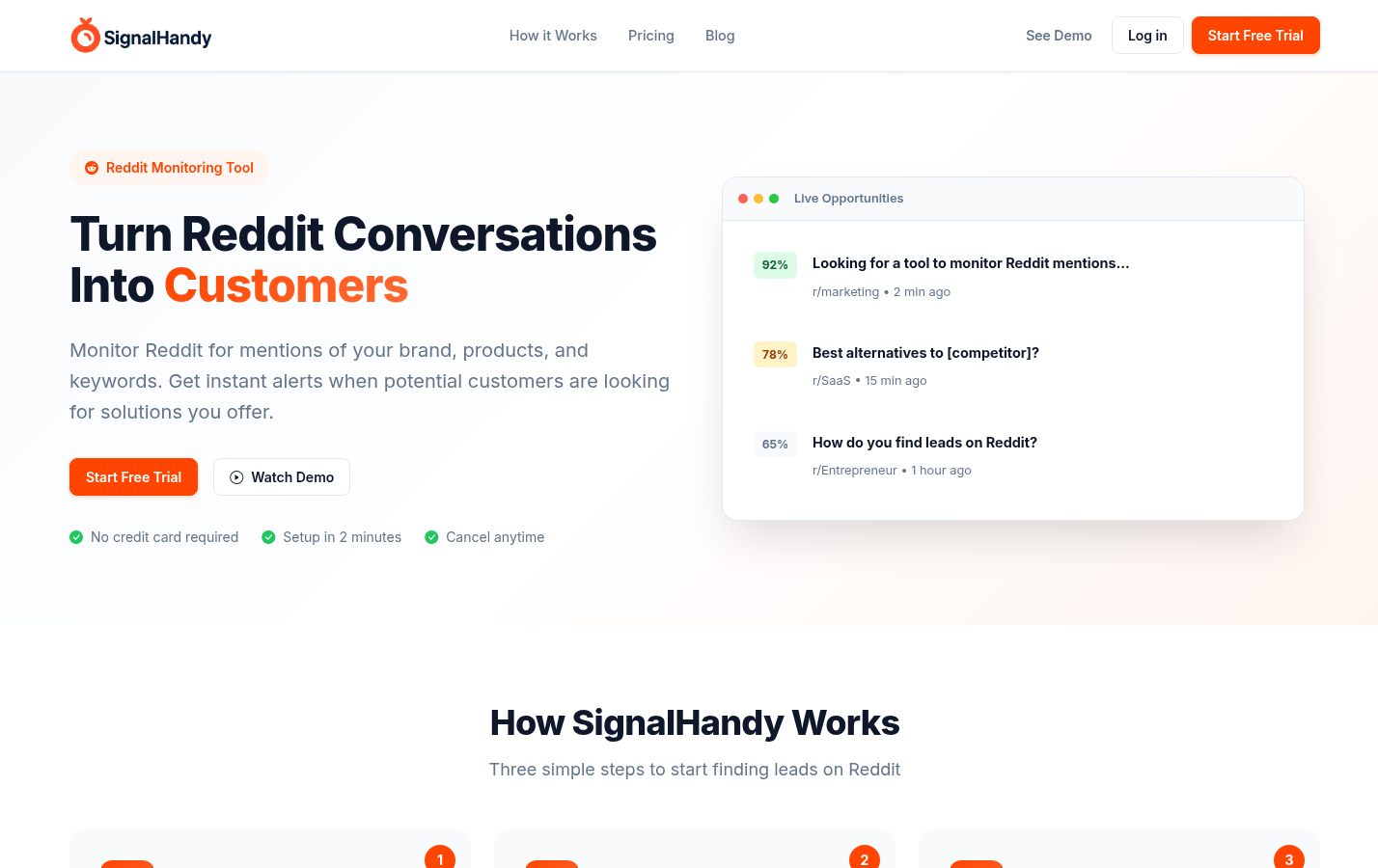
SignalHandy is built for Reddit conversation monitoring and lead discovery. Teams can track research keywords related to their brand, product, competitors, or market; receive alerts when matching posts and comments appear; and use opportunity scoring to prioritize what deserves attention.
For example, a research watchlist might combine a problem phrase, alternative terms, competitor names, and switching-intent terms. Review matching alerts, read the full thread, and add meaningful evidence to the repository with the relevant tags and context. For marketers and founders, suggested replies can help when a relevant conversation calls for a useful, human response. The researcher still needs to decide whether a pattern is meaningful.
Native search and spreadsheets for focused one-off studies
For exploratory work, native Reddit search plus a spreadsheet is a strong low-cost method. It gives you direct control over the communities included, the time period, the queries, and the coding system. It is particularly appropriate when the question is narrow and the research window is finite.
The trade-off is manual effort. You will spend more time finding discussions, and you may miss relevant posts published between research sessions. If ongoing discovery matters, establish a monitoring cadence or use a dedicated tool to surface new conversations.
Avoid the Research Mistakes That Produce Misleading Reddit Insights
Reddit research fails in predictable ways. The most common is treating visible discussion as representative demand. Other mistakes include relying on one subreddit, confusing upvotes with prevalence, ignoring dates, extracting quotes without context, and using a handful of posts to justify a decision already made.
Use corrective habits instead:
- Sample across relevant communities and time periods.
- Record queries, filters, dates, and inclusion criteria.
- Preserve full-thread context around every important quote.
- Keep counterexamples and unresolved questions in the repository.
- Separate direct evidence from interpretation.
- Label confidence and state who the insight may or may not apply to.
- Validate consequential claims with other research methods.
Another common error is treating silence as proof. A topic may be absent because rules prohibit it, users solve the problem elsewhere, the language is different from your search terms, or the relevant audience does not use that subreddit. Absence is a signal to investigate, not a conclusion.
Create a Repeatable Reddit Research Cadence
A research cadence turns scattered observations into an institutional asset. For a one-off project, define the research window, complete the collection and synthesis phases, then archive the repository with the final recommendation and open questions.
For continuous listening, use a lightweight rhythm:
- Weekly: Review new keyword matches, add meaningful evidence, and flag time-sensitive conversations.
- Monthly: Cluster findings, update prioritized themes, share notable shifts, and assign next actions.
- Quarterly: Review the keyword map and community map, retire stale terms, add emerging language, and assess whether insights influenced decisions.
Each cycle should produce a small, usable package: an insight log, prioritized themes, evidence links, open questions, confidence levels, and a recommended next action. Assign an owner, then create a feedback loop with product, content, sales, customer success, or leadership. Research only becomes valuable when the team knows what changed because of it.
Make Reddit Research Useful by Turning It Into Evidence-Backed Decisions
Reddit can offer a rare view into how people frame real problems when they are not responding to your survey or reading your marketing. But that value disappears when researchers mistake anecdotes for proof or collect quotes without context.
Search broadly, preserve the surrounding conversation, code patterns consistently, investigate contradictions, and test conclusions with other evidence. The result is not just a list of Reddit posts; it is a defensible decision about what to build, say, investigate, or prioritize next.
Teams that need continuous keyword-based discovery can explore SignalHandy for Reddit monitoring and opportunity triage.