Most onboarding research fails for a simple reason: teams search for the word "onboarding" and miss the conversations where customers actually describe getting stuck.
On Reddit, people rarely say, "I have an onboarding issue." They ask how to connect an integration, complain that setup is confusing, wonder what to do next, or admit they cannot get their team to use a new tool. Those threads can reveal the obstacles between sign-up and first value - if you search for them deliberately. For a broader research process, see Reddit Research: The Definitive Guide to Market and Customer Insights.
Define the onboarding moment and question types you need to find
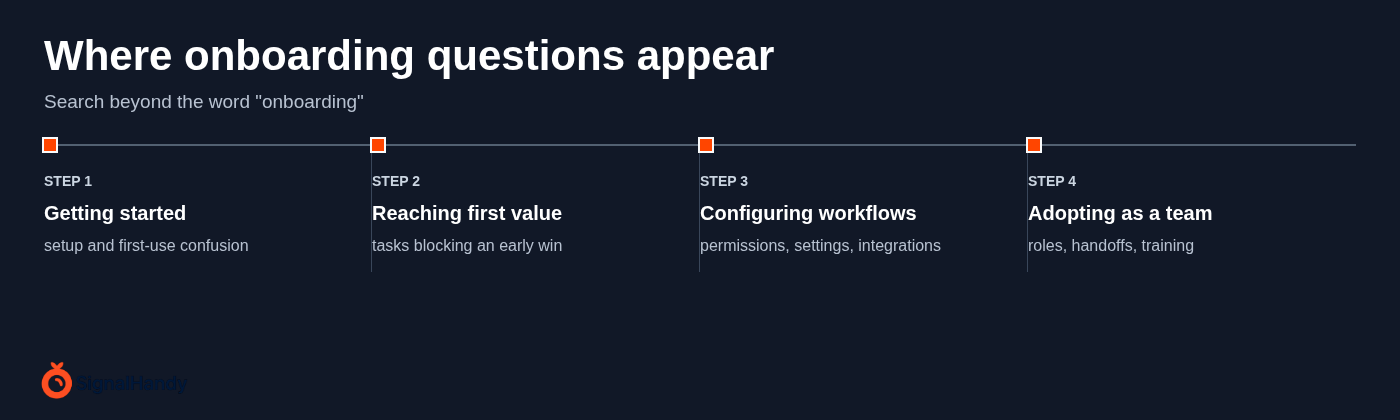
Start by defining the moment you are investigating. Customer onboarding questions are questions that arise while someone is trying to create an account, configure a workspace, import data, connect another tool, invite colleagues, or complete the first meaningful task in your product category.
Do not mix these with pre-purchase evaluation questions. "Which project management tool is best?" is useful market research, but "How do I migrate our tasks without losing due dates?" points to onboarding friction. The second question gives your team something concrete to improve.
Your goal is not a folder full of Reddit links. Build a prioritized list of recurring questions that includes the customer's wording, the audience affected, the onboarding stage, and a link to the supporting discussion.
Build a seed list from your current onboarding flow
Write down the milestones a new customer must pass before reaching value. For a B2B product, that list often includes account creation, initial configuration, data import, integrations, permissions, teammate invitations, workflow setup, and the first successful outcome.
Next to each milestone, list the questions someone might ask when blocked. If the milestone is inviting teammates, likely searches include "how do I add users," "roles and permissions," "team access," and "why can't my colleague see." If the milestone is data migration, include "import CSV," "move data," "migration," "duplicate records," and "data mapping."
Use more than your own product vocabulary. Add feature names, competitor names, category terms, abbreviations, and the less precise phrases customers use before they learn the official terminology. A user may search for "connect my calendar" rather than "calendar synchronization," for example.
Turn onboarding friction into Reddit search queries
Combine a product or category term with language that signals an active task, uncertainty, or frustration. Start with high-intent modifiers such as "how do I," "can't figure out," "stuck," "setup," "getting started," "migration," "integration," and "best way to."
Use quotation marks when the exact wording matters. Searching for "getting started" alongside a category can surface explicit early-use discussions. Broader combinations work better when you want variety, such as a category term plus setup, workflow, or integration.
For brand research, search your product name alongside words such as setup, help, issue, confusing, migrate, integrate, and alternative. Run the same searches with common misspellings or shorthand product names.
Use question-pattern searches to find explicit asks
Explicit questions are the fastest way to collect useful onboarding evidence. Try patterns such as:
- "how do I" + your product category
- "getting started" + product type
- "can't" + the key task, such as "can't import contacts"
- "best way to" + onboarding task, such as "best way to migrate projects"
- your product name + "how do I"
Save the entire question and read the surrounding thread. A title such as "Need help with setup" is weak evidence by itself; the comments may reveal that the real problem is unclear permissions, an unsupported data format, or a missing expectation about how the product works.
Use problem-pattern searches to find questions users do not phrase as questions
Some of the strongest onboarding signals do not look like questions at all. Search for terms such as "confusing," "overwhelmed," "takes too long," "what am I missing," "is there a way," "doesn't make sense," and "gave up."
Implicit friction is often more valuable than a polished feature request. A customer who says, "I spent two hours trying to set this up and still do not know which setting matters," is identifying an expectation gap. The fix may be a better first-run path, not another configuration option.
Search the subreddits where new users ask for help
Good onboarding research happens in communities where people are comfortable admitting what they do not know. Look beyond a brand's own subreddit and include product-specific communities, category communities, role-based groups, adjacent-tool communities, and customer-success discussions.
For example, a SaaS company serving sales teams may find useful setup questions in communities for sales operations, CRM users, revenue leaders, and closely related software. A project-management product may learn more from role-specific communities than from a broad entrepreneurship forum.
Begin with a focused list of active subreddits. Expand only when you see the same themes recur elsewhere. Before participating, read each community's rules carefully. Use Reddit first to learn from people, not as an excuse to add promotional replies to unrelated threads.
Prioritize communities by audience and onboarding context
Choose subreddits based on fit, not subscriber count. A smaller community is often more useful when its members closely resemble your target customer and discuss implementation details openly.
- Audience fit: Do posters match the roles, company sizes, and use cases you serve?
- Onboarding context: Are people discussing adoption, setup, migration, workflows, and tool decisions?
- Activity: Are new threads and comments appearing regularly enough to provide current signals?
- Beginner openness: Do people ask basic questions without being dismissed or redirected immediately?

Use Reddit search filters to surface the most useful threads
Use a repeatable search routine rather than browsing casually. Search Reddit broadly first, then repeat your query within the most relevant subreddits. Compare relevance-sorted results with new results so you can see both durable pain points and recent changes in customer behavior.
Set a time window when possible. Recent discussions are especially important after a product launch, pricing change, integration update, or shift in your target market. Older posts can still expose persistent documentation or onboarding problems, but they should not be treated as current without checking for newer evidence.
Search comments as well as posts. A thread that begins as a product recommendation request may develop into a detailed exchange about permissions, setup failures, or a workaround discovered after the original poster tried the product.
Look for high-signal thread patterns
Save threads with repeated follow-up questions, multiple people reporting the same hurdle, practical workarounds, or comments showing that someone consulted the documentation and remained confused. Those patterns are stronger than a single complaint because they connect the issue to a real task.
Pay attention when answers reveal an expectation the product failed to set. For example, if several commenters explain that an integration must be configured in a separate admin area, the onboarding flow may need to state that earlier and link directly to the right step.
Common mistake: treating a loud post as a universal problem. An isolated complaint, an unusual configuration, or a heavily downvoted misunderstanding is not enough to justify a major onboarding change. Look for corroboration across searches, dates, and communities.
Find unanswered questions about your brand and category
Brand searches help you find gaps that generic category research cannot. Search your product name, common misspellings, abbreviated names, comparison phrases, and the problem customers are trying to solve. Someone may never mention your product while describing a workflow your onboarding should support better.
Unanswered questions are especially revealing. They can signal a missing help-center article, vague in-app copy, a hard-to-find integration guide, or a support process that is not meeting customers where they look for help.
If a thread is relevant and the community permits it, a genuinely helpful response may be appropriate. But do not turn research into indiscriminate outreach. The immediate value is often internal: improve the product experience, documentation, and onboarding messages so fewer people encounter the same barrier.
Capture each finding with enough context to act on it
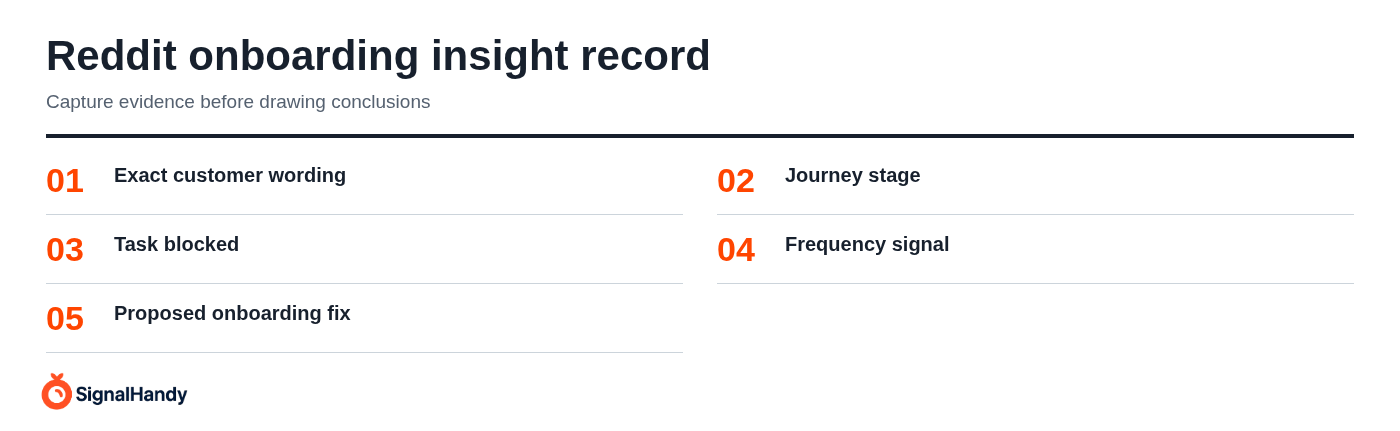
Use a lightweight research record for every strong finding. The record should make sense to a product manager, customer-success lead, or content writer who never saw the original thread. Teams that need a shared view of recurring themes can also use a Reddit voice of customer dashboard.
- Exact customer wording
- Reddit URL and subreddit
- Date and relevant comment context
- User segment clues, such as role, company size, or experience level
- Onboarding stage and task attempted
- Workaround, if one appeared
- Whether a useful answer emerged
Preserve wording verbatim. Customer language is useful for help-center headings, setup checklists, onboarding emails, tooltips, and product prompts. It also prevents teams from translating a simple customer need into internal jargon.
For internal reports, anonymize and aggregate insights. The point is to understand patterns, not to expose individual Reddit users or treat their posts as public permission to profile them.
Separate recurring onboarding problems from one-off complaints
Cluster findings by the underlying job or obstacle, not by the exact search term that found them. "Where do I start?", "What should I configure first?", and "I do not know which option to choose" may all belong to a setup-confidence cluster. Other common clusters include migration, permissions, integrations, team rollout, and first-use guidance.
Then prioritize each cluster using five practical criteria: frequency, severity, proximity to activation, strategic customer fit, and your ability to address it. A problem that affects many new ideal customers before they reach first value deserves attention even if it is less dramatic than an edge-case complaint.
Seek repeated evidence across different queries, subreddits, and dates. This is how you avoid mistaking a highly visible thread for a widespread onboarding issue.
Analyze the language around recurring complaints
Read the words customers use before, during, and after the blocked task. Before the task, they may reveal an expectation: "I assumed I could..." During the task, they describe confusion: "I cannot find..." Afterward, they explain the desired outcome: "I just need my team to..."
That sequence helps distinguish a feature gap from a guidance gap. It also exposes terminology problems. If customers repeatedly use a word your product never uses, consider adopting that language in onboarding copy rather than forcing them to learn internal labels first.
Note emotional language as well. "Overwhelming," "risky," and "time-consuming" indicate what the onboarding experience needs to reduce, while phrases such as "I just want to get my first report running" clarify the outcome that matters.
Validate Reddit themes against your own customer evidence
Reddit is valuable directional evidence, not a replacement for customer validation. Cross-check promising themes with support tickets, onboarding call notes, product analytics, sales objections, churn feedback, and customer interviews. For measurement beyond raw mentions, see How to Measure Reddit-Assisted Conversions Across the Customer Journey.
If a Reddit theme suggests people struggle with importing data, check whether new accounts abandon the import step, whether support receives similar requests, and whether customer-success managers hear the same concern. Agreement across sources gives you a stronger case for changing the onboarding experience.
Turn the language you found into a short validation question. For example: "When you first imported your data, what part, if any, felt unclear or took longer than expected?" Ask it in onboarding calls or a targeted survey, then compare responses to the Reddit pattern.
Turn the strongest questions into onboarding improvements
Each question cluster should lead to a specific intervention, not a vague note to "improve onboarding." Match the solution to the obstacle: a first-run checklist for unclear next steps, a contextual tooltip for an unfamiliar setting, a setup-wizard change for a recurring configuration error, or an integration guide for a complex connection process.
Other useful interventions include migration templates, role-specific onboarding emails, help-center articles, in-product examples, and proactive outreach from customer success for high-value accounts. The best default is to fix the closest point to the blocked task. Do not send users to a long article when a missing label or one-step explanation inside the product would solve the problem.
Document each proposed change with a simple before-and-after structure: customer question, likely root cause, proposed intervention, owner, success metric, and review date. Measure outcomes such as completion rate for the affected step, time to first value, related support volume, or adoption of the relevant feature.
Monitor new onboarding questions instead of repeating manual searches
Manual Reddit research is effective at the start, but it becomes inefficient when you track many keywords, monitor multiple communities, release product changes frequently, or need to catch questions while they are still timely.
At that point, organize terms into keyword groups: brand mentions, product features, category tasks, competitor references, and common frustration phrases. Send relevant findings into a review queue, use relevance scoring to prioritize likely customer conversations, and keep a human responsible for judging context and deciding whether any response is appropriate.
SignalHandy is one option for ongoing Reddit monitoring. It tracks relevant posts and comments, scores opportunities for business relevance, and can surface possible replies, while leaving the final judgment and posting decision to your team.
SignalHandy
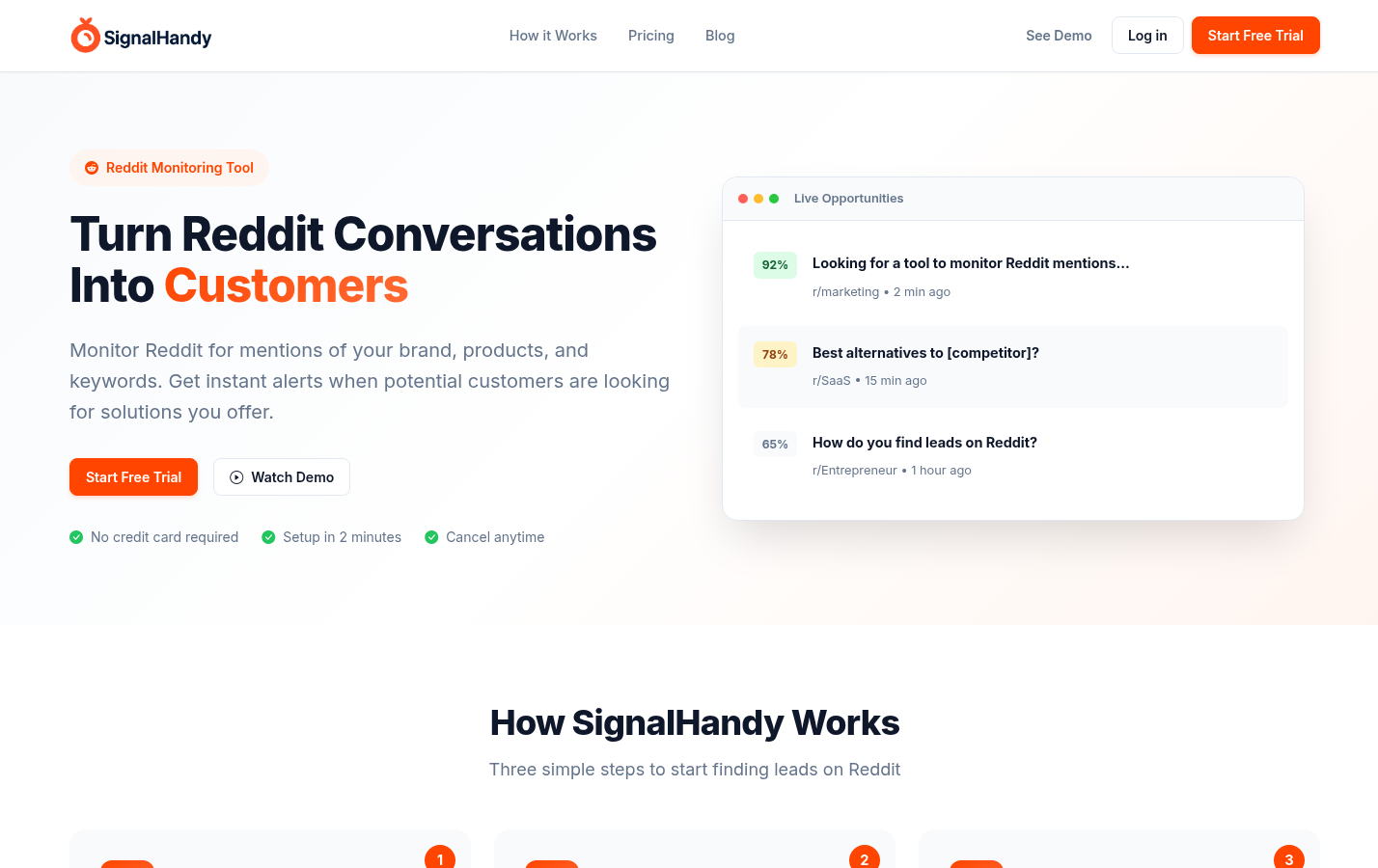
SignalHandy is best suited to marketers, founders, and growth teams that need to monitor Reddit conversations around product terms, competitors, customer problems, or industry keywords without repeatedly running the same manual searches. Near-real-time alerts and digest options can help a team spot emerging onboarding questions and review them while the surrounding context is still fresh.
Its scope is deliberately narrow: it is a Reddit monitoring and lead-discovery tool, not a general social listening suite, CRM, or automated posting service. Choose it when Reddit is a meaningful source of customer language and onboarding insight; use another research source alongside it when your audience primarily discusses problems elsewhere.
Build an evidence-led onboarding backlog from Reddit
Finding customer onboarding questions on Reddit is less about clever searching than disciplined research. Search for real task language, save the context around each question, cluster repeated friction, validate it against your own customer evidence, and turn the strongest themes into measurable improvements.
That process produces an onboarding backlog grounded in how customers actually describe their problems, not how your team assumes they do. When ongoing visibility is needed, SignalHandy can monitor relevant Reddit conversations so your team does not have to restart the research process every week.