Reddit marketing fails most often before anyone writes a bad post. A team finds a promising subreddit, assumes audience fit means permission to promote, and publishes from memory or an outdated spreadsheet. The result is a removal, a frustrated moderator, and a community that now recognizes the brand for the wrong reason.
Tracking subreddit rules is not busywork. It is the operating system that lets a marketing team participate usefully, protect its reputation, and avoid treating every relevant community like an available ad channel.
Start with a subreddit inventory, not a posting calendar
Before planning posts, build one shared inventory of every subreddit your team may monitor, comment in, or post to. This should be a central working document, not a collection of bookmarks owned by individual marketers. If you are still identifying communities, use this guide on how to find relevant subreddits for your target audience.
Give each community a row or card with the information your team needs to make a sound decision:
- Subreddit name and URL
- Main topic and audience
- Target buyer or influencer fit
- Approximate member scale and visible activity level
- Named internal owner
- Current marketing status
- Date rules were last verified
- Link to the full rule record
Use simple status labels from the start: watch, engage, approved to post, or do not use. A community may be valuable for customer research even when it is completely unsuitable for company posts.
The common mistake is treating every relevant-looking subreddit as a viable promotional channel. It is not. Some of the most commercially relevant communities have strict anti-promotion rules, and attempting to force a campaign into them can damage trust faster than it generates leads.
Evaluate marketing relevance before investing research time
Start with three questions. Does the community include your target buyer, user, or an influencer who shapes their decisions? Are members discussing recurring problems your product can genuinely help solve? Can your team make a useful contribution without making the conversation about your company?
If the answer to the last question is no, put the subreddit in a research-only or watch status. Monitoring a community can still reveal customer language, objections, competitor perceptions, and content ideas. It does not automatically create permission to join the conversation as a brand. For a broader research process, see this guide to Reddit research.
Keep audience relevance separate from marketing permission. A founder community may contain exactly the people you want to reach, for example, but prohibit unsolicited product links and brand-led posts. That is not a loophole to work around; it is a boundary to respect.

Check the full rule set in the right order
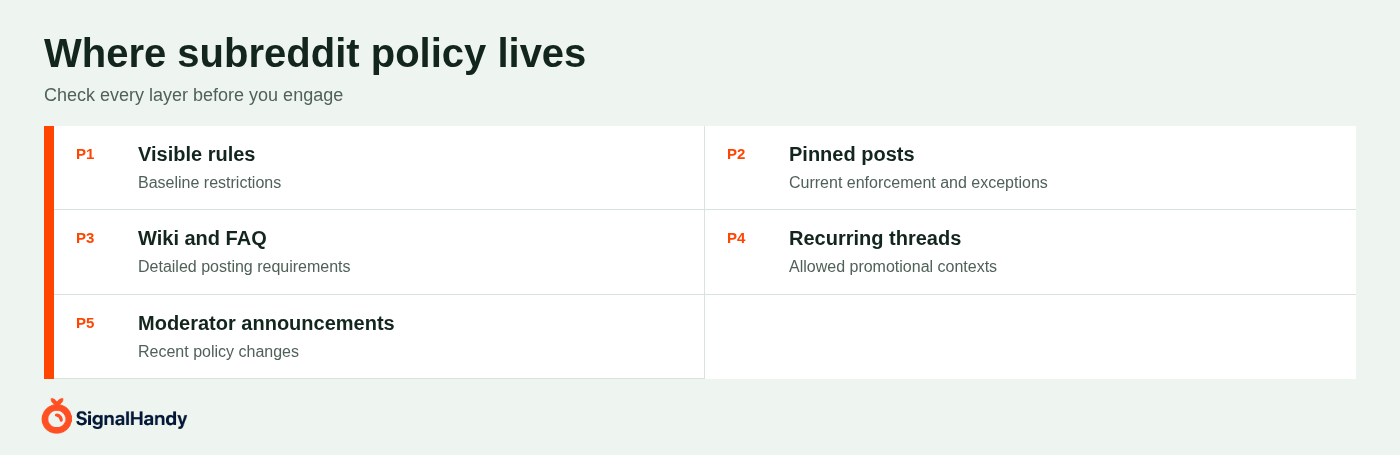
When you check a subreddit, do not stop at the visible rules list. Open the community and review its About section or sidebar first, then work through pinned posts, the wiki or FAQ, recurring threads, and recent moderator announcements.
Think of subreddit policy as layered. Visible rules establish the baseline, but a pinned post may explain how those rules are being enforced this month. A weekly thread may be the only place where a product mention is permitted. A wiki may contain title requirements or detailed restrictions that do not fit in the main rules panel.
Record the date you checked each source. Moderators can revise rules, change thread formats, or adjust enforcement without notifying every marketer who saved an old link.
Read rules for intent, not just prohibited words
Vague language requires a practical team interpretation. "No spam" rarely means only "do not post the same text twice." It usually means do not use the subreddit primarily to acquire customers, redirect members off-platform, or insert a product mention where it does not answer the question.
Translate each policy into behavior your team can follow. If a subreddit says "be relevant," note what relevance looks like: answer the specific question first, disclose affiliation where appropriate, and do not add a link unless it is necessary and allowed.
Look closely for restrictions that can affect an otherwise thoughtful contribution:
- External links, shortened links, affiliate URLs, or newsletter signups
- Self-promotion, company mentions, product demos, and discount codes
- Surveys, research requests, job posts, or hiring announcements
- AI-generated content or low-effort template replies
- Cross-posts, reposts, and duplicate submissions
- Claims that require evidence, such as performance promises or comparisons
Do not assume that a comment follows the same rules as a post. Some communities allow helpful comments but prohibit promotional links in every format. Others reserve all commercial discussion for one designated thread.
Inspect recurring threads and moderator guidance
Recurring threads often determine the real path for acceptable participation. Search the subreddit for weekly promotion, feedback, hiring, showcase, self-promo, or "share your project" threads. Then read the current version, not just an old archived example.
Capture the exact conditions. A thread may require a specific format, a flair, a minimum account age, a karma threshold, one comment per week, or a disclosure statement. It may also ban follow-up replies that bump a promotional comment.
Check moderator announcements for recent changes and pay attention to sticky posts. A pinned announcement can temporarily suspend promotion, redirect posts to another thread, or tighten rules after a wave of spam.
Turn rules into a structured rule record
A bookmark is not a rule-tracking system. Create a repeatable record for each subreddit so different team members reach the same conclusion from the same evidence.
Use fields that support a real publishing decision:
| Field | What to record |
|---|---|
| Source URL | The direct link to the rule, wiki, thread, or announcement |
| Date verified | The date and the person who checked the source |
| Content allowed | Comments, text posts, links, images, research requests, or none |
| Commercial-content policy | Whether company mentions, promotion, or disclosure are permitted |
| Link policy | Allowed destinations, link limits, and any restrictions on tracking or affiliate links |
| Format requirements | Required flair, title format, account thresholds, and thread placement |
| Frequency caps | Limits by account, week, thread, or campaign |
| Prohibited claims | Claims, comparisons, or content types the community explicitly rejects |
| Escalation contact | Whether modmail is appropriate and the internal person who handles it |
| Evidence and examples | Quoted rules, useful approved examples, and relevant removal context |
Keep direct evidence separate from your team's interpretation. One field can quote the rule or link to it; another can state the operational takeaway, such as "Brand comments are permitted only when answering a direct product question, with no link unless requested." That distinction makes assumptions easier to challenge and update.
Use clear statuses instead of a binary allowed-or-not-allowed label
"Allowed" is too broad to guide a campaign. Use statuses that describe what the team may actually do:
- Research only: Monitor conversations but do not participate from a brand or employee account.
- Organic comments allowed: Helpful, non-promotional replies may be appropriate within recorded constraints.
- Post only in designated thread: Commercial or project mentions belong exclusively in a named recurring thread.
- Moderator permission required: Do not post until a moderator approves the specific contribution.
- Approved campaign channel: A documented post format is currently permitted for the stated campaign.
- Exclude: Do not use for marketing activity.
When rules are unclear, choose the more conservative status. Ambiguity is a reason to observe or ask for clarification, not an invitation to test the boundary with a campaign post.
Assign ownership and a review cadence
Every active subreddit needs a named internal owner. That person is responsible for keeping the record current, but the record itself should live in a central system that community, demand generation, brand, and campaign teams can access.
Do not rely on a single employee's recollection of what a moderator said three months ago. Teams change, campaigns overlap, and details such as a required flair or weekly posting limit are exactly the details people forget.
Set review triggers rather than relying only on a monthly cleanup. Re-check a community:
- Before launching a campaign or publishing a planned post
- When a post or comment is removed
- When a moderator replies to your team
- When a new recurring thread appears or an old one changes format
- When a sticky post, wiki page, or AutoModerator message changes
- At a defined interval for communities where you engage regularly
Add a lightweight change log. Note what changed, who verified it, the source link, and how it affects planned activity. A one-line entry such as "September 12: self-promo thread moved from Friday to monthly; owner paused weekly schedule" is enough to prevent a stale workflow from continuing.
Define an escalation path for uncertain cases
Set clear conditions for when a marketer must pause. Good triggers include conflicting rules, a planned post that includes a commercial link, an unclear disclosure requirement, a removed contribution with no explanation, or a campaign with legal or brand-sensitive claims.
If the answer is already in the rules, do not ask moderators to repeat it. If you need clarification, use modmail and keep the request short and specific. Explain the proposed contribution, the intended placement, and the value it offers members. Do not send a generic pitch asking whether your company can "share something valuable."
For example: "We would like to answer questions in the monthly tools thread with a short disclosure that we build X and no external link. Does that fit the current thread rules?" That is easier for a moderator to assess than a vague request for permission to promote.
Monitor rule changes and enforcement signals continuously
Watch for signals that deserve a record review: removed posts, AutoModerator messages, locked threads, flair changes, new sticky posts, moderator comments, and changes in recurring thread titles or descriptions. A removal is not always proof of a formal rule change, so record the specific reason rather than rewriting the entire policy based on one incident.
Set alerts around the conversations that matter
Monitor the target subreddit alongside keywords related to promotion threads, moderator updates, self-promotion, rules, pinned announcements, your brand, competitors, and the problem your product solves. This helps the team notice relevant discussions and possible compliance changes without manually scanning every community all day.
Use alerts as a discovery mechanism, not as an automated compliance decision. A keyword match can surface a useful thread or an AutoModerator notice, but the final decision still requires checking the subreddit's current official guidance.
Use SignalHandy to find conversations that need a rules check
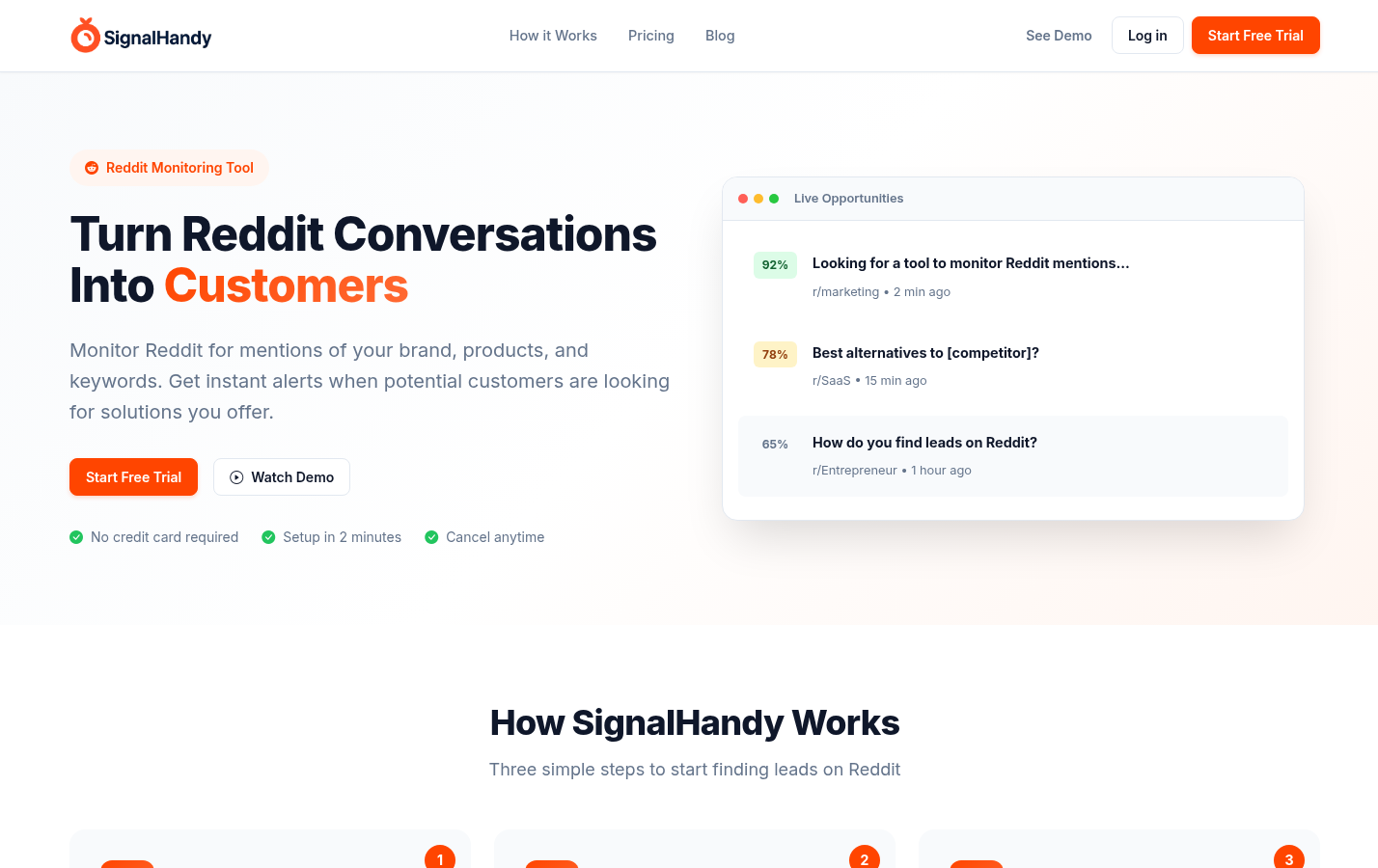
SignalHandy is most useful when your team needs to monitor Reddit posts and comments for brand names, competitor mentions, industry terms, and customer problems across the communities in your inventory. Its alerts and opportunity scoring can help marketers spot conversations worth reviewing, including recurring threads or discussions that may warrant a fresh rules check before anyone responds.
The important limitation is that SignalHandy does not replace the rule record or make a final judgment about whether a reply is permitted. A surfaced mention is an opportunity to investigate, not approval to engage. Teams that need a focused Reddit monitoring workflow, rather than a broad social media suite, can use it to find relevant conversations while keeping current subreddit guidance as the source of truth.
Build campaign briefs from approved rules, not memory
Before a marketer drafts a Reddit post or comment, convert the current rule record into a short brief for that exact subreddit and format. This is where policy becomes usable execution guidance.
A useful brief should state the permitted objective, approved post type or recurring thread, required flair, link decision, value-first angle, prohibited language, owner, and fallback action if the contribution is removed. It should be specific enough that a writer does not have to infer what "keep it non-promotional" means.
For example, a brief might say: "Answer direct questions in the monthly tools thread. Use one paragraph explaining the workflow, disclose that you work on the product, include no link unless a commenter asks, and do not mention discounts or free trials. If removed, do not repost; send the removal to the subreddit owner for review."
For time-sensitive campaigns, require a final check against the live rule sources immediately before publishing. The brief is a guide, but the live subreddit remains authoritative.
Use a pre-publish compliance checklist
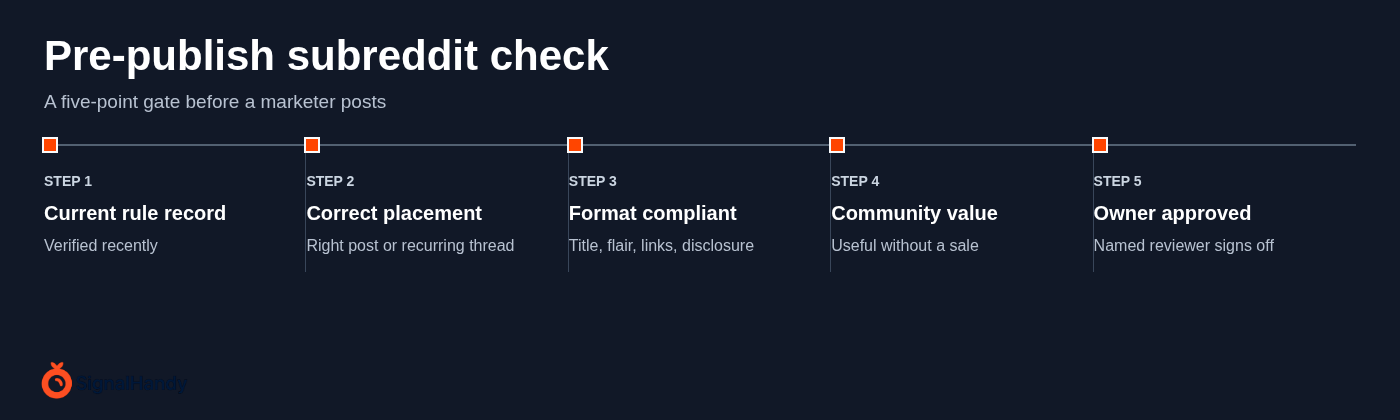
Give the person publishing a five-point gate. It should take less than two minutes, but it should catch the avoidable violations that lead to removals.
- Current rule record: The record was verified recently and links to the live sources.
- Correct placement: The post or comment belongs in the right subreddit and, if required, the right recurring thread.
- Format compliant: Title, flair, links, disclosure, account requirements, and frequency limits are met.
- Community value: The contribution answers the question or adds useful context without requiring a sale.
- Owner approval: The named reviewer has approved the format when the workflow requires it.
Add one firm stop condition: do not publish if the team cannot point to a current source supporting the intended format. This prevents the classic mistake of using a competitor's visible post as proof that something is allowed. A competitor may have moderator permission, a different account history, or a post that simply has not been removed yet.
Learn from removals without arguing with moderators
Removals and warnings are process feedback. Pause similar activity, preserve the post, message, thread context, and stated reason, then update the rule record and future campaign briefs. Do not let the same team repeat the same mistake because the learning stayed in one person's inbox.
A respectful response is appropriate only when it can resolve genuine uncertainty. Acknowledge the decision, ask one focused question if needed, and avoid debating moderation in public comments. Moderators are not obligated to negotiate your campaign plan, and public arguments rarely improve a brand's standing in a community.
Measure compliance separately from performance. Track preventable removals, approval rate, and useful engagement alongside clicks, traffic, or leads. If a tactic produces short-term attention while creating repeated moderator conflict, it is not a successful Reddit strategy.
Common rule-tracking mistakes that put Reddit campaigns at risk
Treating comment rules as post rules. Comments can feel informal, but they may be subject to the same self-promotion, link, and disclosure limits as posts. Check the format you actually intend to use.
Assuming a competitor's post proves permission. You do not know whether it was approved, grandfathered, missed by moderators, or removed later. Follow official guidance, not anecdotal precedent.
Make subreddit compliance part of your marketing workflow
The durable approach is simple: inventory the communities, verify every policy layer, translate rules into structured records, assign ownership, monitor for changes, and build each campaign brief from current approvals. That loop lets your team move faster because people are no longer guessing at the same questions before every post.
For teams monitoring Reddit at scale, SignalHandy can help surface relevant posts and comments across the conversations that matter. Keep the rule record, not the alert, as the final decision source before your team engages.