Reddit rarely hands you a neat report saying, "Customers keep struggling with this." The evidence is scattered across posts, comments, subreddits, and months of conversation. One person asks for an alternative, another describes the same friction in different words, and a third requests the feature that would solve it.
Finding recurring Reddit discussion threads means turning those scattered signals into a pattern you can trust. Done well, it helps you spot customer pain points, unanswered questions, competitor weaknesses, and useful conversations to join without confusing one loud post for broad demand.
Define the recurring conversation you want to track
A recurring Reddit thread is not a duplicate post. It is a repeatable discussion pattern: the same need, complaint, comparison, or question appearing in different language across separate conversations.
For example, "reporting is too manual," "I spend hours assembling client reports," and "why can't I export a clean report?" may all point to one underlying problem. Treating them as separate topics hides the opportunity. Grouping them too broadly, however, makes the finding unusable.
Start with one use case and the decision your research should support. You might be trying to improve onboarding, validate a feature request, identify content gaps, understand why people leave a competitor, or find relevant conversations where a helpful reply is appropriate.
Write that decision down before searching. "Find mentions of our product" is too vague. "Determine whether new users repeatedly struggle to connect their first data source" gives you a clear signal to look for and a useful way to evaluate what you find.
Choose a pattern category before you search
The strongest recurring patterns usually fall into categories that lead to a team action. Good places to begin include:
- Customer pain points and workflow frustrations
- Unanswered questions about your brand or product category
- Feature requests and missing integrations
- Competitor complaints and switching intent
- Product recommendation requests
- Onboarding questions and setup friction
Do not collect broad social mentions simply because they exist. A hundred casual references to a category may be less useful than five detailed posts explaining why users cannot complete a task. Prioritize patterns that can inform research, product decisions, documentation, content, or thoughtful participation.

Build a keyword map from the language Redditors actually use
Search works best when you stop relying on a single polished keyword. Build a compact keyword map that covers how people describe the product, the problem, and the outcome they want.
For a B2B product, your map might include brand and product names, category terms, competitor names, pain phrases, desired outcomes, and question wording. If you sell analytics software, "analytics dashboard" is a starting point, but phrases such as "building reports manually," "send reports to clients," or "can't get the numbers I need" may uncover far better conversations.
Redditors usually describe symptoms, not marketing categories. They say what went wrong, what took too long, or what they wish were easier. That conversational language is often where the useful recurring threads are hiding.
Add problem, comparison, and intent modifiers
Modifiers turn a broad term into a thread-finding query. Add phrases that indicate frustration, comparison, or a live need:
- "how do I"
- "struggling with"
- "alternative to"
- "switching from"
- "wish it had"
- "recommend"
- "is there a way to"
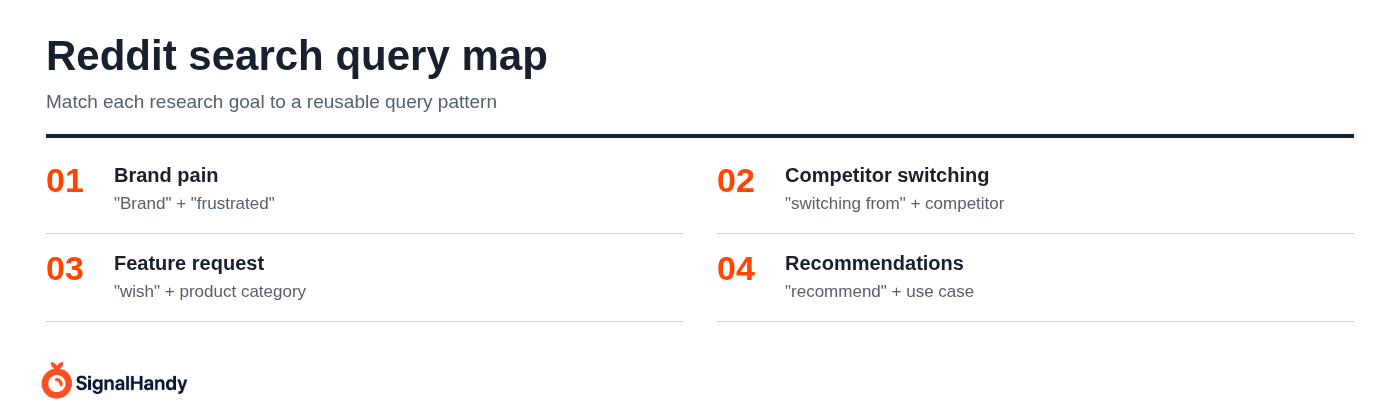
Combine them with your category, brand, or competitor. For example, "alternative to [competitor]" can surface switching conversations, while "wish it had" plus a category term can reveal feature gaps. "How do I" plus a workflow can expose onboarding or documentation problems.
Keep the phrases separate in your notes rather than forcing them into one giant search string. You want to learn which language produces valuable results and which language produces noise.
Include exclusions to reduce irrelevant results
Some terms have multiple meanings, attract unrelated industries, or repeatedly surface low-value discussions. Record those sources of noise and exclude them where the search tool allows it.
Be careful not to exclude a useful variant by accident. If a product name overlaps with a hobby, for example, exclude the hobby term rather than removing the product name altogether. Maintain a small log of rejected meanings and irrelevant communities. Over time, that log makes your searches faster and more precise.
Search Reddit broadly with native search and Google operators
Use a simple sequence: search a relevant subreddit first, expand to all of Reddit, then use Google to find older or exact-phrase discussions that native search may miss. Each result is a lead to evaluate, not proof that you have found a recurring pattern.
Use Reddit search to learn the communities and vocabulary
Start inside the subreddit most likely to contain the conversation. Search for a phrase, a brand plus an issue, or a category term with an intent modifier. Useful formats include:
- subreddit:community phrase
- "exact wording"
- brand name + issue term
- competitor name + "alternative"
Read several results, not just the top one. Note which words posters use, where the discussion happens, and whether commenters describe the same root need. Those observations should feed back into your keyword map.
Native Reddit search is useful, but it is not a complete archive. Sorting can be inconsistent, older posts may be difficult to retrieve, and an exact phrase may not surface even when a close match exists. Do not mistake a thin result page for evidence that nobody is discussing the issue.
Use Google to surface older and exact-match discussions
Google is especially useful when you need exact phrasing, older posts, or a wider view across communities. Try adaptable searches such as:
- site:reddit.com/r/community "pain phrase"
- site:reddit.com "competitor" "switching from"
- site:reddit.com "wish it had" "product category"
- site:reddit.com "recommend" "use case"
Open the post before recording it. Verify the date, subreddit, context, and whether the wording reflects a genuine user need. A result title can be misleading, and an old thread may describe a problem that has already been resolved.
Start with the subreddits where the pattern is most likely to recur
A focused watchlist is more valuable than searching Reddit as one undifferentiated mass. Look for category communities, profession-specific communities, use-case communities, and competitor-adjacent subreddits where people discuss real workflows.
For each subreddit, document the audience, rules, posting frequency, recurring topics, and relevance to your research goal. A community can be active yet still be a poor source of commercial insight if its members are not your likely users or if self-promotion rules make participation inappropriate.
Separate high-signal communities from high-volume communities
Large communities produce volume. Smaller specialist communities often produce clearer language and better context. A subreddit for a specific job role may have fewer posts than a broad business forum, but its members can explain the exact constraints, tools, and outcomes that shape a buying decision.
Do not equate subscriber count, upvotes, or comment volume with relevance. A detailed thread from five experienced practitioners can be more useful than a popular post full of generic reactions. Look for specificity: what the person tried, what failed, and what they need next.
Turn individual posts into a recurring-thread dataset
Once you find relevant posts, capture them consistently. A simple spreadsheet or database is enough at first. Create columns for:
- Post or comment URL
- Date
- Subreddit
- Original wording
- Theme or root problem
- Context and use case
- Engagement and notable replies
- Sentiment
- Potential action
Normalize similar wording into a shared theme, but preserve the original language beside it. "Need better reports," "reporting takes forever," and "client reporting is painful" may belong in the same theme, while their exact phrasing tells you how people actually experience the problem.
Tag the root problem, not just the topic
Surface-level tags are easy to create and hard to act on. A tag like "reporting" tells you the subject, but not the decision or friction behind it.
Use diagnostic tags instead: "manual reporting takes too long," "cannot share reports with clients," or "reporting setup is confusing." The same principle applies to feature requests. "Integration request" is less useful than "needs an integration because data must be exported manually every week."
Root-problem tags make it easier to count recurring pain, identify ownership, and decide whether the right response is a product investigation, a help article, a piece of content, or a conversation to monitor.
Keep the original customer language beside your summary
Your summary should make the dataset scannable, but the verbatim quote preserves nuance. Exact phrases can strengthen positioning, reveal onboarding friction, and help a reply sound natural rather than promotional.
Avoid turning one comment into a universal customer claim. A single detailed complaint is evidence worth tracking, not a mandate to change your product. The value comes when independent people describe the same underlying issue over time.
Validate that a thread pattern is genuinely recurring
Before acting on a theme, look for repetition across separate authors and dates. Ideally, the same underlying need appears in more than one relevant community as well. You also need enough context to understand what people are trying to accomplish and why existing options fall short.
This prevents common errors: treating a single viral post as a market trend, confusing a temporary outage with a product-wide issue, or assuming one subreddit's culture reflects the whole audience.
Measure frequency, intensity, and relevance together
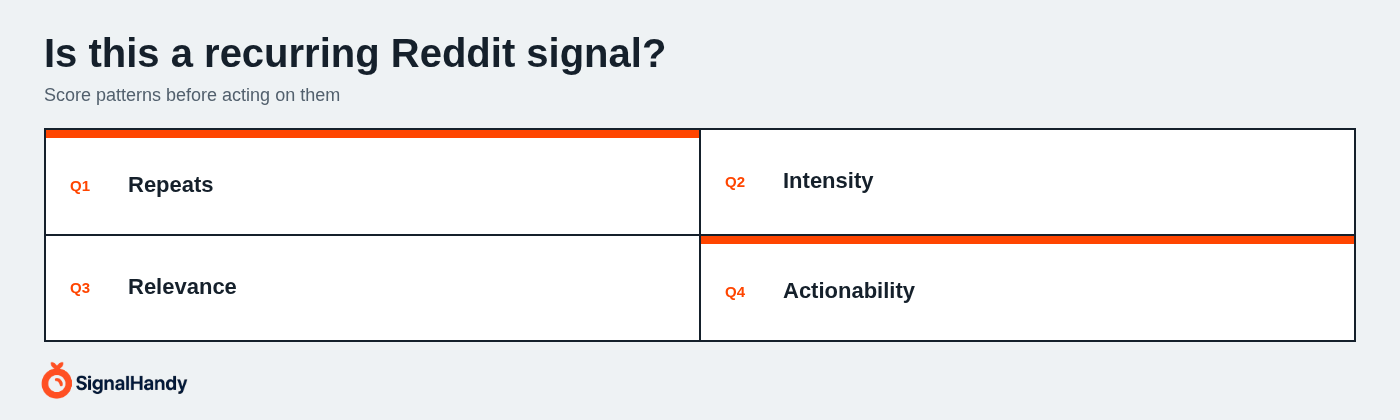
Do not chase frequency alone. The best opportunity may not be the most common one. Evaluate each pattern on four practical dimensions:
- Repeats: Does it appear across independent posts or comments?
- Intensity: Is there clear frustration, urgency, or a costly workaround?
- Relevance: Does it fit your audience, offer, or research question?
- Actionability: Does it point to a useful reply, insight, content asset, or product decision?
You do not need artificial precision. A simple low, medium, or high rating is usually enough to compare themes. A low-frequency issue with strong urgency and a close product fit may deserve attention before a common but vague complaint.
Find recurring opportunity types worth acting on
Not every Reddit mention is a sales lead, and treating every conversation that way is the fastest route to unhelpful outreach. Review recurring patterns by the action they support: research, content, product feedback, customer education, or a genuinely useful participation opportunity.
Unanswered brand and category questions
Look for questions with no reply, incomplete answers, or advice that is clearly outdated. To find unanswered questions about a brand on Reddit, search your brand name with question phrasing such as "how do I," "is there a way to," or "does anyone know," then inspect whether the comments actually resolve the issue.
These threads can expose support-documentation gaps and content opportunities. For onboarding-related questions, learn how to find customer onboarding questions on Reddit. If you reply, answer the question directly, disclose your connection when relevant, and follow the subreddit rules. A useful explanation is better than a thin invitation to book a demo.
Competitor complaints and switching conversations
Competitor discussions matter when dissatisfaction is specific. "I hate this tool" is usually generic venting. "I need to switch because it cannot support client reporting across multiple accounts" is a defined unmet need.
Watch for alternative requests, migration questions, and explicit phrases such as "switching from." Only participate when you can explain a relevant solution without hijacking the thread. If the community expects peer recommendations rather than vendor input, use the conversation as research instead of forcing a pitch.
Feature requests, onboarding friction, and recurring pain points
Repeated requests can reveal missing capabilities, confusing workflows, or a mismatch between user expectations and product behavior. Onboarding posts are especially valuable because they show where a user becomes stuck before they see value.
Route a validated theme to the right team with representative evidence: a few links, the exact language used, the root-problem tag, relevant subreddit context, and your assessment of frequency and intensity. Product, customer success, and content teams need more than a screenshot of one complaint.
Recommendation posts and customer-language research
Recommendation threads show what buyers prioritize. Someone asking for a tool may care most about ease of setup, reporting, privacy, price predictability, integrations, or support. For a practical workflow, see how to find product recommendation posts on Reddit. These criteria can improve landing pages, comparison content, and sales enablement.
They also reveal audience vocabulary. Use the words people use to describe the job they need done, not the language your company prefers internally. But respect community norms: in many subreddits, a promotional vendor reply will damage trust even if the product is relevant.
Set up ongoing monitoring so new threads do not get missed
Manual search is useful for initial research, but recurring themes keep developing after your first review. Set up saved searches, a review cadence, and alerts so you can see new conversations without repeating the entire process every week.
Keep alert groups separate: one for brand terms, one for competitors, one for category problems, and one for high-intent phrasing such as "alternative to" or "recommend." That structure makes the review queue manageable and helps different teams focus on the signals they own.
Use SignalHandy for keyword-based Reddit monitoring and opportunity review
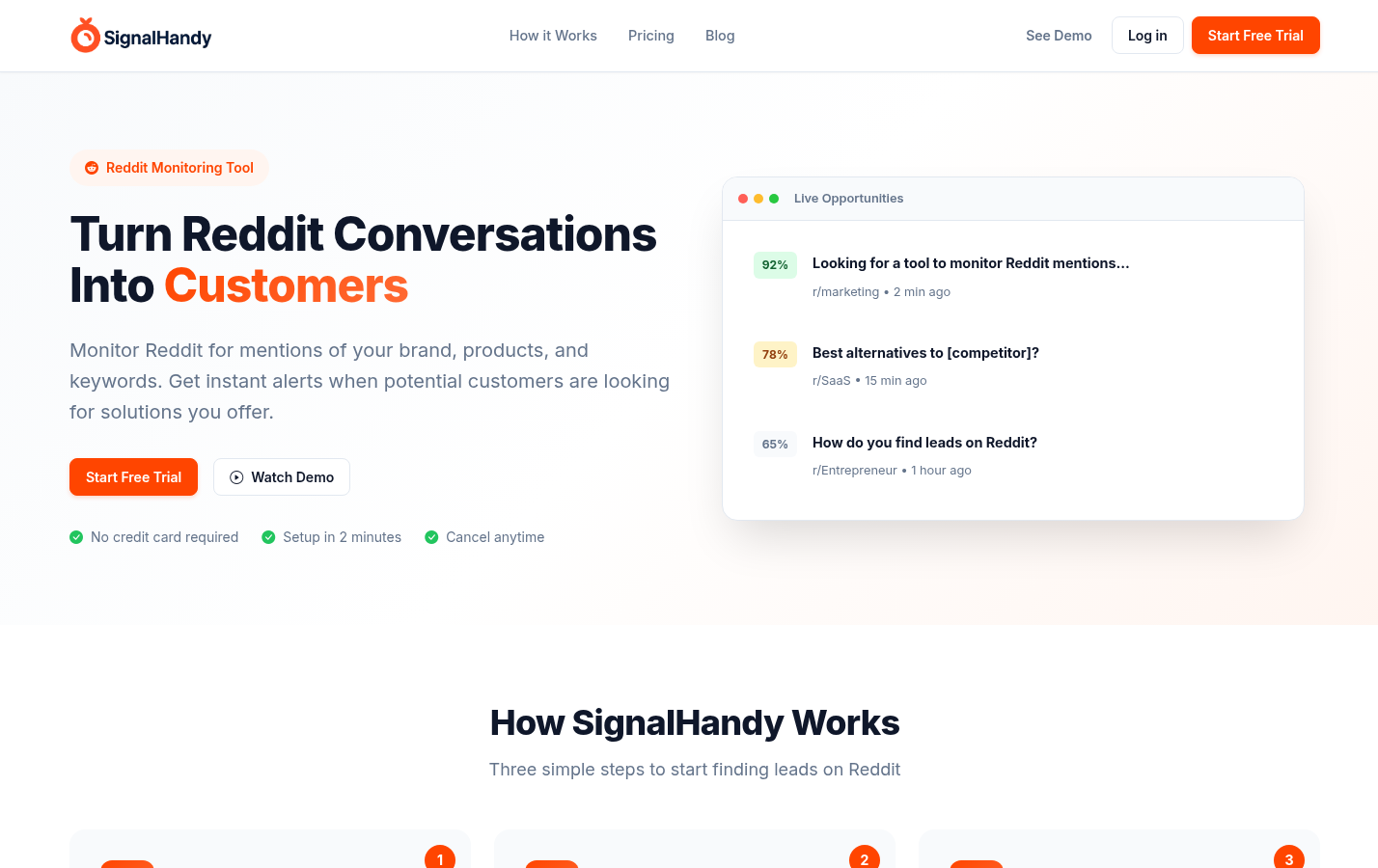
SignalHandy is built for this Reddit-specific workflow. You can track keyword sets for your brand, competitors, category problems, and intent phrases; receive alerts for relevant Reddit posts and comments; and review opportunities with relevance scores.
The keyword map and root-problem tags you created earlier make those alerts substantially more useful. Rather than monitoring a broad phrase alone, you can separate a competitor name from switching language or pair a category term with a known pain phrase.
SignalHandy also provides reply suggestions. Use them as a starting point, not as automatic posting. Check the post context, community rules, and your ability to add real value before writing anything publicly.
Review patterns on a schedule and turn them into decisions
Set a weekly or biweekly review. Group new findings with existing themes, remove duplicate cross-posts, and note whether frequency or intensity is changing. The goal is not a larger archive. It is a clearer decision log.
For every validated theme, assign an owner and a next step: reply to a current question, write or update documentation, create educational content, investigate a product issue, share feedback with customer success, or continue monitoring until more evidence appears.
Avoid common Reddit research mistakes
Overcounting cross-posts is a common mistake. The same link shared across several subreddits is not the same as independent people raising the same need. Count unique authors and distinct discussions, then record cross-posts as distribution rather than separate demand.
Another mistake is mistaking the loudest comment for broad demand. Strong language is useful for measuring intensity, but it does not replace repetition and relevance. Always consider the subreddit context: a complaint in a niche enthusiast community may not represent your primary audience.
Finally, do not reply with a pitch when the thread needs useful context. Read the rules, answer the actual question, be transparent about your affiliation, and leave the conversation alone when vendor participation is unwelcome.
Make recurring Reddit threads a repeatable source of insight
The process is straightforward: define the signal you need, map the language people use, search broadly, collect evidence, validate recurrence, and monitor the themes that matter. The discipline is in separating a real pattern from isolated noise.
When you do that consistently, Reddit becomes more than a place to find occasional mentions. It becomes a source of customer language, product feedback, content ideas, and well-timed opportunities to help. For ongoing visibility, use SignalHandy to monitor relevant keywords and review new Reddit opportunities as they appear.